| Study | Design & population | Finding & comparison |
|---|---|---|
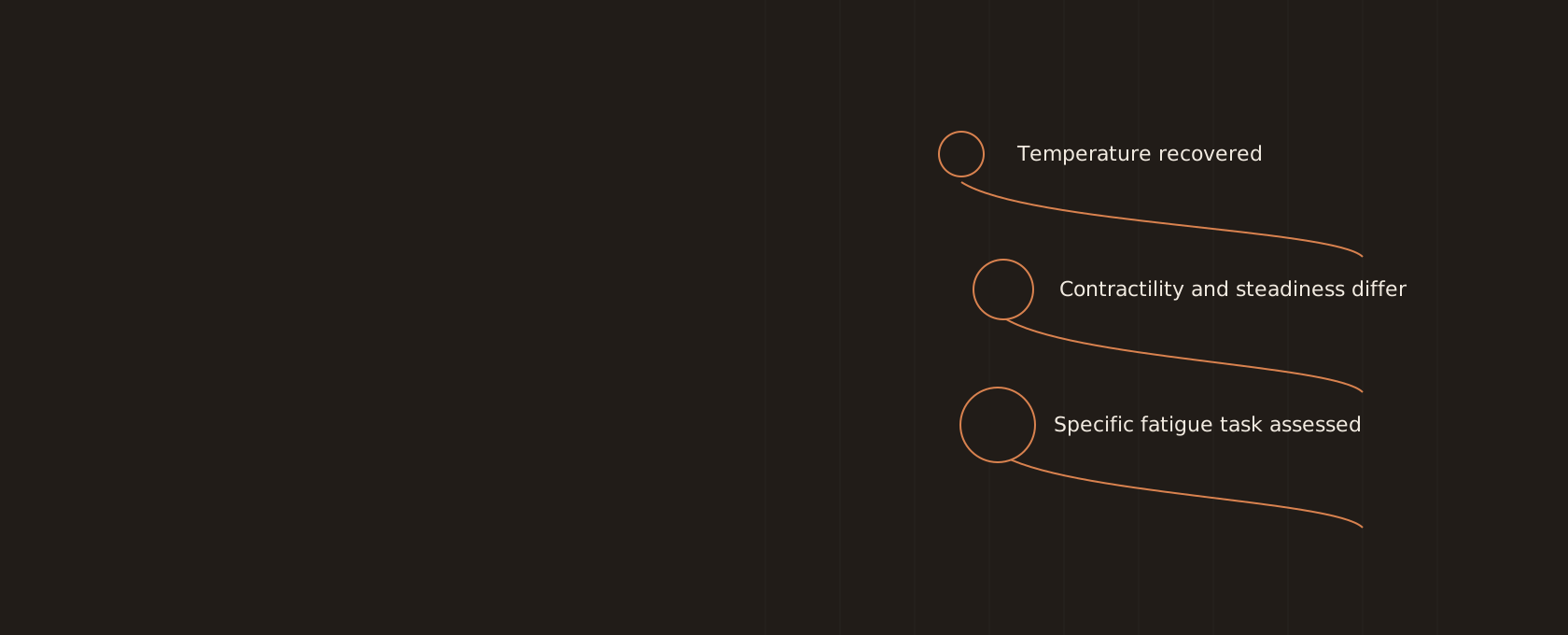
| 2019 · Cernych M ↗ | Before-after neuromuscular physiology study Apparently healthy young adults Participants: 16. Finnish sauna-induced whole-body hyperthermia | After temperature recovery, muscle contractility and steadiness changed but the tested submaximal task did not produce greater neuromuscular fatigability. Comparison: Before versus two hours after exposure Small male sample |
| 2020 · Rissanen JA ↗ | Repeated-measures exercise and sauna study Recreationally active, sauna-experienced Participants: 27. Traditional sauna | Strength exercise followed by sauna showed the greatest measured neuromuscular fatigue; sauna alone also temporarily reduced selected force measurements. Comparison: Sauna alone and strength, endurance or combined exercise followed by sauna No matched exercise-without-sauna conditions described |
| 2023 · Ahokas EK ↗ | randomized crossover experiment basketball players Participants: 16. post-exercise infrared sauna · two trials one week apart | Infrared recovery attenuated the subsequent jump-performance decline and reduced reported soreness in this small sample. Comparison: passive recovery after resistance exercise Small sport-specific acute trial; subjective outcomes; not all performance measures improved. |
Original publication: Accelerated muscle contractility and decreased muscle steadiness following sauna recovery do not induce greater neuromuscular fatigability during sustained submaximal contractions.
Were all residual muscle responses favorable after cooling?
No uniform improvement was established. The study found faster contractile properties and decreased muscle steadiness after temperature had recovered, while the tested sustained contraction did not produce greater neuromuscular fatigability. Those are separate observations with different interpretations.
The paper’s detailed title is useful because it keeps the mixed results together. Faster contractility is not synonymous with stronger voluntary performance or better coordination, and no greater fatigability in one task is not the same as improved readiness for every activity. The source helps clarify what remains after an acute heating challenge under its testing conditions. It should not become a simplified claim that cooling restored every function or that a residual response was universally beneficial or harmful. Each measured endpoint needs its own place in the account.
How was recovery distinguished from being acutely hot?
The principal comparison was made after body temperature had returned toward its preheating level, rather than only while participants were still exposed to heat. Measurements were obtained before sauna and during the later recovery assessment around a defined laboratory task.
That timing allows investigation of residual effects, but it is not a complete controlled comparison of every possible recovery influence. The abstract describes a before-and-after study in a small group of young men. It does not supply a separate randomized non-heated comparator that resolves all effects of elapsed time, repeat testing or rest. This appraisal preserves the observed pattern without assigning more causal control than the indexed design provides. The study’s selected group and challenge also limit transfer to athletes, clinical populations or ordinary leisure sessions that differ from the research exposure.
Does accelerated contractility establish stronger performance?
The reported contractile response is a physiological property, not proof of improved maximum strength or competitive performance. A muscle responding faster under a particular assessment does not establish that every voluntary movement or sports task improves.
The study also recorded lower steadiness. That concurrent finding is a reason to resist an all-beneficial label. A complete interpretation needs the method used to assess each property and the question the task addresses. This page does not infer a generalized coordination deficit or benefit beyond those measurements. The useful contribution is that related neuromuscular outcomes can change differently even after temperature recovery. A source summary should preserve those differences rather than select the fastest-sounding result and attach a broader strength claim that the experiment did not establish.
What does the submaximal fatigability finding establish?
The tested sustained isometric task did not provoke greater neuromuscular fatigability after the recovery period. That is a bounded result about the specific load and assessment. It does not establish improved resistance to fatigue in every activity or exact equivalence under all conditions.
Task specificity matters because sustained submaximal contractions, a jump, maximal force and a race involve different endpoints. A null difference in one cannot provide the result for another. The study can be valuable for understanding residual physiology without predicting the next competition. Nor should the absence of greater fatigability erase the concurrent changes in contractility and steadiness. Together, the observations form a mixed account rather than a single score for how successfully a person recovered from sauna.
Does recovered body temperature mean all functions are unchanged?
The experiment directly illustrates why that assumption is too broad. Temperature had returned toward baseline while some neuromuscular measures still differed. Temperature is one measurement, not a complete test of every functional system.
The finding does not create a public rule about how long to wait before training. A particular laboratory assessment after a recovery interval is not a validation of safety for every person at that interval. The exposure, participant characteristics and task remain part of the comparison. A source-based account should therefore use the timing to interpret the experiment, not turn it into a countdown instruction. The same caution works in reverse: the residual measurements cannot establish that every recreational session leaves an athlete impaired in the same way or for the same duration.
How does the exercise-loading study relate?
The exercise-loading experiment reported its greatest measured neuromuscular fatigue after strength work followed by sauna and selected force reductions after sauna alone. That study examined different activity sequences and time points. It did not provide matched exercise-without-sauna conditions for every loading.
Those design differences should be considered before declaring the findings contradictory or combining them into a precise extra fatigue penalty. The present study focused on a residual laboratory task after temperature recovery. The loading study assessed several routines and acute force outcomes. Each contributes useful detail, but neither supplies the other’s unmeasured comparison. The appropriate synthesis retains the endpoint and sequence rather than reducing every result involving heat and muscle to a universal recommendation for or against training after sauna.
Can favorable infrared jump recovery settle this result?
A separate randomized crossover in male basketball players found a smaller countermovement-jump decline and less soreness after infrared recovery than passive rest. That is an acute recovery comparison after a defined resistance session, not a replication of the residual contraction experiment.
The modality, preceding activity, sample and outcome differ. A favorable jump finding cannot erase reduced steadiness in another task, and the steadiness result cannot determine whether the basketball players’ jump outcome was reproducible. Keeping those scopes separate makes apparently differing findings more informative. The question for a reader is which task and interval matter to the claim. A broad recovery label does not make the experiments interchangeable or permit a personal training prescription to be assembled from their different observations.
What is the proportionate conclusion and review boundary?
The grade is C for a small physiological study with mixed residual findings and a specific task-fatigability result. It does not establish a general strength benefit, sports-performance prediction or individualized exposure rule. Its contribution is a more precise account of how several neuromuscular properties can differ after heating and recovery.
This appraisal read the indexed abstract and refreshed bibliographic information. Full-text measurement procedures, complete statistical decisions, formal risk of bias and financial disclosures were not comprehensively assessed. Funding and competing interests remain unreported rather than assumed absent. Research conditions are not a routine to copy. Where a health condition or medication affects intended sauna use, discuss suitability with a qualified clinician rather than treating one task result or a recovered temperature reading as personal clearance.
Explore the evidence with a tool.
Questions, considered
Questions about this study
Did the sauna-recovery muscle study show that every neuromuscular measure improved?
No. Muscle contractility became faster while steadiness decreased after body temperature returned toward baseline. The tested contraction task did not produce greater fatigability. Mixed changes like these should be reported separately, because faster contractile behavior does not automatically mean better coordination, sporting performance or recovery.
Follow the sourceWas muscle function measured while participants were still overheated in PMID 30481721?
The principal recovery comparison was made after body temperature had returned toward its preheating level. This distinguishes residual effects from the immediate strain of being hot. Even after temperature normalizes, some physiological measures can differ, so feeling cooled down does not establish that every function has returned unchanged.
Follow the sourceCan the muscle-contractility experiment predict next-day athletic performance?
Not directly. It used a small group of healthy young men and a specific laboratory contraction task after substantial heating. Sporting events involve different skills, loads and recovery intervals. The findings help describe neuromuscular physiology but do not establish a reliable effect on an athlete’s next competition.
Follow the sourceFollow the evidence
Sources & references
Research summaries in this edition are based on indexed abstracts unless otherwise noted. A source link is not a claim of medical review.
- Accelerated muscle contractility and decreased muscle steadiness following sauna recovery do not induce greater neuromuscular fatigability during sustained submaximal contractions.
Cernych M, Baranauskiene N, Vitkauskiene A, Satas A, Brazaitis M
Volume 63, pages 10-19 · PMID 30481721
Open-access flag: not recorded.Abstract-level editorial review - Acute Neuromuscular and Hormonal Responses to Different Exercise Loadings Followed by a Sauna.
Rissanen JA, Häkkinen A, Laukkanen J, Kraemer WJ, Häkkinen K
Volume 34, issue 2, pages 313-322 · PMID 31490429
Open-access flag: not recorded.Abstract-level editorial review - A post-exercise infrared sauna session improves recovery of neuromuscular performance and muscle soreness after resistance exercise training.
Ahokas EK, Ihalainen JK, Hanstock HG, Savolainen E, Kyröläinen H
Volume 40, issue 3, pages 681-689 · PMID 37398966
Open-access flag: yes.Abstract-level editorial review - Benefits and risks of sauna bathing.
Hannuksela ML, Ellahham S
Volume 110, issue 2, pages 118-126 · PMID 11165553
Open-access flag: not recorded.Abstract-level editorial review