| Study | Design & population | Finding & comparison |
|---|---|---|
| 2022 · Kunutsor SK ↗ | prospective cohort analysis Finnish population cohort Participants: 2575. habitual sauna bathing | Sauna frequency and inflammation showed joint associations with mortality, without randomized exposure assignment. Comparison: joint inflammation and sauna-frequency groups Observational joint categories; shared KIHD cohort; residual confounding. |
| 2018 · Kunutsor SK ↗ | cross-sectional and longitudinal cohort analysis Population cohort Participants: 2269. habitual sauna · Baseline and 11-year measurements | Greater frequency was associated with lower inflammatory-marker levels in several analyses, but sauna frequency was not associated with GGT. Comparison: Once-weekly sauna Observational markers |
| 2020 · Behzadi P ↗ | Randomized-order crossover physiology study Healthy middle-aged and older adults Participants: 20. Finnish sauna | Selected cytokines increased after sauna, whereas CRP did not change; the response depended on exposure pattern and marker. Comparison: Seated time control Acute response |
Original publication: Inflammation, sauna bathing, and all-cause mortality in middle-aged and older Finnish men: a cohort study.
What question was the study designed to answer?
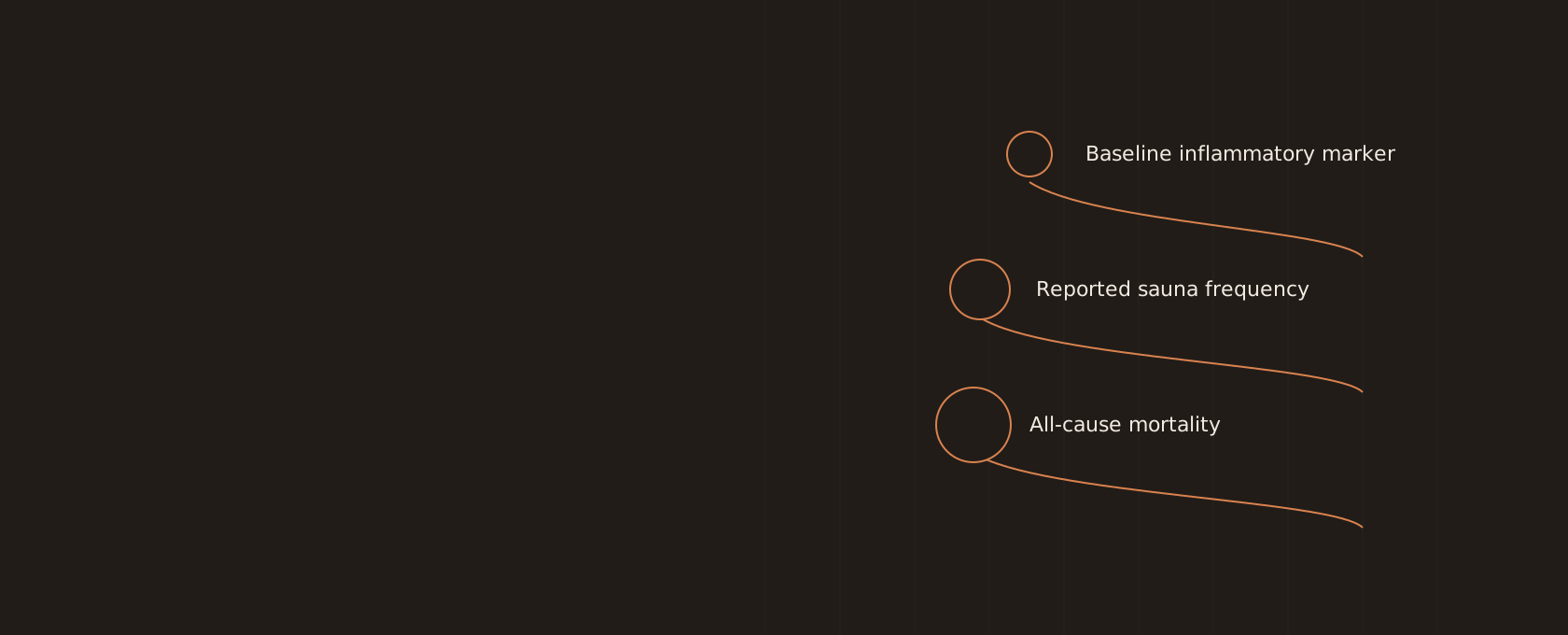
The study examined separate and joint associations of high-sensitivity C-reactive protein and sauna frequency with later all-cause mortality. High-sensitivity CRP is the inflammatory marker named in this analysis. The investigators were asking about a combined risk profile, not testing a course of sauna intended to change that marker.
That distinction is easy to lose when the study is summarized under a broad inflammation benefit. A mortality comparison among baseline categories can be informative even if the analysis never demonstrates that sauna changed inflammation. The source belongs in the evidence discussion as a prognostic cohort analysis, with the marker, exposure and outcome kept as separate parts of the research question.
How were inflammation and sauna habits assessed?
Serum high-sensitivity CRP was measured using an assay, while sauna habits were collected through a self-administered questionnaire. The cohort consisted of middle-aged Finnish men. These baseline measurements supplied the classifications used for the later mortality comparisons.
An assay result is not the same type of information as a reported habit, and neither establishes a complete history throughout follow-up. The study can relate the starting profile to later outcomes, but it does not show that every participant remained in the same inflammation or exposure category. The analytical value lies in examining those characteristics together, with their measurement and timing explicit rather than treating them as fixed lifelong traits.
What did the combined categories show?
Inflammation and sauna frequency showed joint associations with all-cause mortality. The paper describes a pattern across the observed categories, with a favorable interpretation for more frequent sauna in the context of elevated inflammation. That observation remains a population-level comparison without randomized exposure assignment.
It does not mean that a person with a high CRP measurement can restore their risk profile by adding sauna. The clinical meaning of an individual measurement, the reasons for it and the consequences of changing exposure were not established by this comparison. The account retains the direction of the observed association while refusing the untested step from a category pattern to an individual compensation strategy.
Did the study show that sauna lowered CRP?
The main joint-category mortality analysis did not test an assigned sauna intervention that lowered CRP. It started with inflammation and sauna information, then related those characteristics to subsequent deaths. It cannot be described as direct evidence that sauna reduced inflammation in the participants.
This is a distinction between analytical questions, not a denial that inflammation is worth investigating. To examine marker change, a study would need appropriately timed repeated measurements and a design capable of evaluating the exposure-change question. The separate longitudinal biomarker paper offers relevant observational context, but it should not be merged with this mortality analysis as though the combined result proved an intervention pathway.
Why does a mediation claim require more evidence?
A mediation explanation would propose that sauna changes inflammation and that the change helps produce a mortality difference. Observing baseline sauna frequency, baseline inflammation and later mortality is not enough to establish that sequence. The joint association and the hypothesized pathway are different claims.
A plausible mechanism can organize future research, but it should not be presented as a measured causal chain unless the study actually supports that chain. This paper contributes information about the combined prognostic pattern. It does not identify how much of any sauna association is transmitted through inflammation, or whether changing the marker would alter the outcome. Those require additional analyses and evidence rather than more confident wording.
| Research question | Addressed here? | Evidence boundary |
|---|---|---|
| Do baseline CRP and sauna profiles predict mortality? | Joint associations examined | Exposure was not randomized |
| Did sauna lower CRP? | Not established by this mortality comparison | Requires a marker-change analysis |
| Did a CRP change explain mortality differences? | Not established | Requires evidence for the proposed mediation pathway |
How does cohort overlap affect the evidence count?
This is another analysis within the KIHD framework. Related sauna mortality and biomarker publications can share participants while studying different questions. The new paper adds a joint inflammation question, rather than automatically adding an independent population that reproduces every earlier finding.
Multiple analyses may be valuable for probing the same dataset from different directions, yet they do not remove residual confounding by being numerous. People in the combined categories can differ in other measured or unmeasured ways. A review should separate the contribution of each analysis from the number of independent cohorts behind the broader sauna narrative. This keeps the evidence map informative without allowing publication count to substitute for independent confirmation.
What context do biomarker studies provide?
The longitudinal KIHD biomarker study examined inflammatory-marker associations at baseline and later measurement. It reported differing results across markers rather than a uniform effect on every measure. That source is relevant to the inflammation hypothesis, with its own observational and measurement limits.
A crossover study of circulating inflammatory markers offers a different temporal perspective on sauna exposure. Short-term marker responses and long-term mortality profiles do not answer the same question. Reading across designs is useful when the differences remain visible: what was measured, when it was measured, whether exposure was allocated and which clinical inference is being attempted. None should be used to fill a missing causal step silently.
What is the practical interpretation for readers?
The useful conclusion is that inflammation and sauna habits deserve joint consideration when interpreting this cohort’s mortality findings. The study can help a reader evaluate a research claim and identify questions for discussion. It cannot turn a CRP result into a sauna-dose recommendation or establish that sauna neutralizes an individual’s risk.
An individual decision requires attention to suitability for heat exposure, especially when a medical condition or medication is involved. The safety review supplies a separate evidence context rather than clearance from this cohort. A favorable mortality association should remain an educational finding, with its limitations attached, rather than becoming a reason to change clinical management independently.
What remains unreviewed?
The indexed abstract and verified corpus abstraction were consulted. A free full-text link is recorded, but this editorial summary has not completed a formal full-text risk-of-bias assessment. Detailed model specification, category construction and missing-data handling should be examined directly before assigning a stronger evidentiary interpretation.
Funding and conflicts of interest are not provided in the abstract-level abstraction used here. They remain unreported rather than presumed absent. Numerical cutoffs and joint hazard estimates beyond the existing facts registry are deliberately omitted. The page’s central contribution is conceptual precision: a joint risk profile does not establish marker change, and marker change itself would not automatically establish a causal mortality pathway.
Explore the evidence with a tool.
Questions, considered
Questions about this study
Was CRP a starting characteristic or a demonstrated sauna response?
In the joint mortality comparison, baseline high-sensitivity CRP helped define the starting risk profiles alongside reported sauna habits. The analysis did not demonstrate an assigned sauna course lowering CRP. It related existing characteristics to later deaths, so the result should not be presented as direct evidence of a sauna-induced inflammatory change.
Follow the sourceDoes a joint category establish an inflammation-mediated survival pathway?
No. A mediation claim would require evidence connecting sauna exposure to inflammatory change and that change to the outcome. Observing baseline inflammation, sauna frequency and later mortality does not establish that causal sequence. The joint-category pattern can motivate a pathway hypothesis without showing that inflammation explains the observed mortality association.
Follow the sourceHow should this inflammation paper count beside other KIHD reports?
Count it as a distinct analysis, while checking participant overlap before calling it independent replication. Its contribution is the joint inflammation-and-sauna mortality question. Related KIHD publications can examine other outcomes or measurements in shared participants, so several papers do not necessarily represent several independently recruited populations supporting the same explanation.
Follow the sourceFollow the evidence
Sources & references
Research summaries in this edition are based on indexed abstracts unless otherwise noted. A source link is not a claim of medical review.
- Inflammation, sauna bathing, and all-cause mortality in middle-aged and older Finnish men: a cohort study.
Kunutsor SK, Jae SY, Kurl S, Kauhanen J, Laukkanen JA
Volume 37, issue 12, pages 1225-1231 · PMID 36255556
Open-access flag: yes.Abstract-level editorial review - Longitudinal associations of sauna bathing with inflammation and oxidative stress: the KIHD prospective cohort study.
Kunutsor SK, Laukkanen T, Laukkanen JA
Volume 50, issue 5, pages 437-442 · PMID 29897261
Open-access flag: not recorded.Abstract-level editorial review - Impact of Finnish sauna bathing on circulating markers of inflammation in healthy middle-aged and older adults: A crossover study.
Behzadi P, Gravel H, Neagoe PE, Barry H, Sirois MG, Gagnon D
Volume 52, pages 102486 · PMID 32951736
Open-access flag: not recorded.Abstract-level editorial review - Association between sauna bathing and fatal cardiovascular and all-cause mortality events.
Laukkanen T, Khan H, Zaccardi F, Laukkanen JA
Volume 175, issue 4, pages 542-548 · PMID 25705824
Open-access flag: not recorded.Abstract-level editorial review - Benefits and risks of sauna bathing.
Hannuksela ML, Ellahham S
Volume 110, issue 2, pages 118-126 · PMID 11165553
Open-access flag: not recorded.Abstract-level editorial review