| Study | Design & population | Finding & comparison |
|---|---|---|
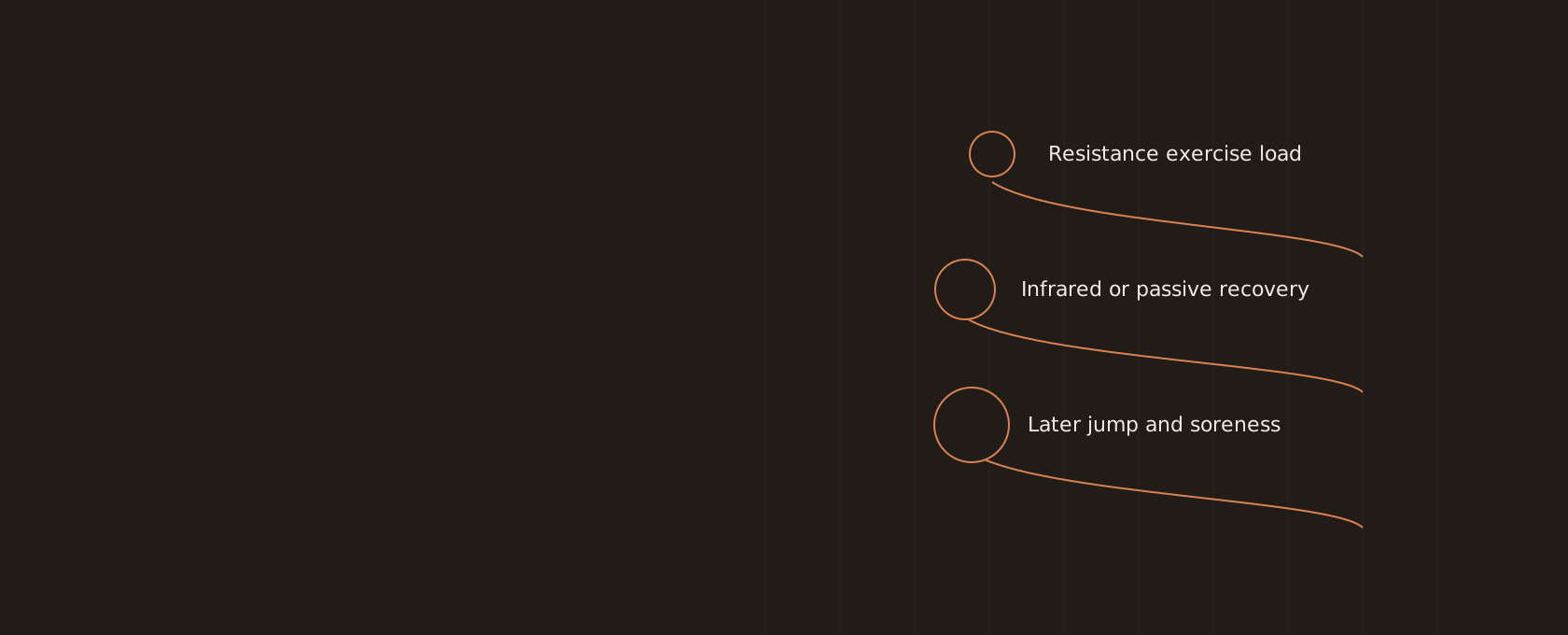
| 2023 · Ahokas EK ↗ | randomized crossover experiment basketball players Participants: 16. post-exercise infrared sauna · two trials one week apart | Infrared recovery attenuated the subsequent jump-performance decline and reduced reported soreness in this small sample. Comparison: passive recovery after resistance exercise Small sport-specific acute trial; subjective outcomes; not all performance measures improved. |
| 2015 · Mero A ↗ | Acute exercise-recovery comparison Healthy physically active male volunteers Participants: 10. Far-infrared and traditional sauna conditions | The abstract reports no recovery differences after the strength session and a higher countermovement jump at one time point after endurance exercise with infrared exposure. It does not directly validate the asserted depth of infrared penetration. Comparison: Recovery with infrared versus no sauna; additional traditional condition Small male-only sample and multiple outcomes. |
| 2025 · Ahokas EK ↗ | pair-matched controlled training study team-sport athletes Participants: 40. infrared sauna · 6 weeks | Infrared recovery did not add significant hypertrophy gains; some power-related measures showed interactions. Comparison: same strength/power training without infrared recovery Pair-matched groups; multiple performance outcomes; not proof of generalized gains. |
Original publication: A post-exercise infrared sauna session improves recovery of neuromuscular performance and muscle soreness after resistance exercise training.
What recovery question did the experiment ask?
The study compared a single infrared sauna session with passive recovery after a defined resistance-exercise load in male basketball players. Its question was acute recovery, not a season-long training adaptation or a trial of muscle growth. The distinction sets the scope before any favorable result is considered.
Recovery was assessed through several kinds of measurement, including performance tests, soreness, perceived recovery and autonomic information. They should not be collapsed into one general success label. A player can report less soreness without every force or sprint outcome improving. This source is useful because it permits an outcome-specific comparison of the recovery conditions after the same general exercise challenge.
How did the randomized crossover structure help?
Sixteen male basketball players completed both recovery conditions in trials separated by a week. The randomized crossover design allows each participant to contribute to the comparison of infrared exposure and passive recovery. This reduces some between-person variation, while randomized order helps address a systematic order effect.
It does not remove every possible source of bias or guarantee applicability outside the sample. The complete methods would need review for adherence, timing, analysis and how subjective outcomes were handled. The participant group also remains sport-specific and male. The design strengthens the acute comparison without turning it into evidence for every athlete, every infrared product or long-term use after repeated training.
What exactly did the recovery condition describe?
The infrared condition followed a complex resistance session combining maximal-strength work and plyometrics. It used a reported temperature of 43 ± 5°C, equivalent to 109.4 ± 9°F. The comparison was passive recovery, rather than another active recovery method or a standardized traditional high-temperature sauna.
The post-exercise context belongs with the heat exposure. A person using a different exercise load, heating environment or recovery interval is not repeating the entire studied intervention merely by choosing the same temperature. These methods describe the research condition, not a validated personal schedule. The source does not establish a minimum effective dose or identify which modified home routine would produce the same measured response.
What did the favorable jump finding actually mean?
The decline in countermovement-jump performance was attenuated after infrared exposure compared with passive recovery. That is a smaller drop in a particular explosive-performance test. It should not be rewritten as complete restoration of strength, improvement above baseline or a favorable result in every measured task.
The performance battery included other outcomes, but the registered favorable summary names jump recovery. A careful reading keeps the test and timing attached, rather than inferring equal changes in sprinting or isometric force. This makes the result more useful for a reader evaluating readiness: the evidence supports a specific measured difference, with other dimensions of performance requiring their own results.
What did the soreness result add?
Players reported less severe soreness and greater perceived recovery after infrared exposure than after passive recovery. These are meaningful subjective observations when comfort or readiness is part of the research question. They remain different from direct evidence of tissue repair or a measured restoration of all neuromuscular function.
The perceptible heat condition also makes a complete review of expectation and blinding methods relevant. This abstract-level summary does not assume those issues were eliminated. The appropriate synthesis presents the subjective findings beside the jump comparison, rather than using one to certify the other. The distinction preserves useful information without allowing the broad word recovery to imply outcomes the study did not establish.
| Outcome | Reported comparison | What it does not establish |
|---|---|---|
| Countermovement jump | Smaller decline after infrared | Full restoration of every performance test |
| Soreness and perceived recovery | More favorable than passive recovery | Direct measurement of tissue repair |
| Overnight autonomic measures | No difference between conditions reported | Universal safety or overnight improvement |
| Muscle growth | Not tested as a long-term endpoint here | An added hypertrophy effect |
Were the session and overnight responses identical?
No. The source distinguishes changes in heart rate and variability during infrared exposure from the night-time comparison. The reported overnight autonomic measurements did not differ between recovery conditions. A temporary response during heating should not be described as a demonstrated improvement in overnight recovery.
The absence of a difference in those measured night-time outcomes also does not establish that every person, exposure or adverse event has been assessed. It belongs to the specific comparison and observation window. This page therefore avoids converting a reassuring abstract statement into general safety clearance, or treating all autonomic measurements as one endpoint with a uniform favorable direction.
Why include the older infrared and swim findings?
The earlier infrared study reported no recovery differences after its strength session, with a favorable jump observation at one assessment after endurance exercise. The swim experiment found worse next-morning performance after its tested sauna condition than after placebo recovery. These are relevant comparisons because they prevent a universal claim about post-exercise heat recovery.
They are not direct replications of the basketball protocol. Sport, exercise load, heating method and assessment timing differed. The findings should therefore inform the scope of the conclusion rather than cancel each other by simple vote. The basketball result remains interesting, while the broader evidence shows why the exact outcome and recovery context determine what can reasonably be claimed.
Does the study establish longer-term muscle development?
No. A single-session recovery comparison cannot establish extra hypertrophy during a training program. The repeated infrared study in female team-sport athletes examined that longer time scale and found no added significant hypertrophy gain beyond training. Some power-related measures showed interactions, rather than generalized improvement in every endpoint.
The later study changes both population and question. It should not be presented as an exact replication of the male basketball trial, but it provides a concrete boundary on extrapolating acute recovery to muscle growth. A reader interested in development over weeks needs the muscle-size measures, not an assumption that less soreness after one session must produce a larger training adaptation.
What remains unassessed in this summary?
The indexed abstract and existing verified abstraction were read. Full-text methods, individual performance analyses, subjective-outcome handling and formal risk of bias have not been comprehensively appraised here. The source’s acute crossover design is valuable without resolving those further review questions.
Funding and conflict-of-interest details are unreported in the abstract-level record used for this page. They are not presumed absent. Numerical result sizes missing from the facts registry were not added. The justified conclusion is a favorable jump-decline and soreness comparison in a small male basketball sample, with other performance outcomes, personal suitability and long-term growth kept separate. That scope preserves both the finding and the limits needed to interpret it.
Explore the evidence with a tool.
Questions, considered
Questions about this study
What recovery outcome improved in the basketball infrared crossover trial?
The decline in countermovement-jump performance after resistance exercise was smaller following infrared exposure than passive recovery. Participants also reported less soreness. This is a specific result in male basketball players, rather than evidence that every athletic performance measure or every form of recovery improves with infrared sauna.
Follow the sourceDid infrared recovery worsen overnight autonomic measurements in the basketball trial?
The reported nighttime heart rate and heart-rate variability did not differ between recovery conditions, despite immediate autonomic changes during infrared exposure. Separating those time points matters. An acute increase in cardiovascular strain during heating does not mean the study found the same difference during the subsequent night.
Follow the sourceWas the basketball infrared trial a long-term muscle-building study?
No. It compared recovery after two exercise trials using a crossover design. The outcomes concerned subsequent performance, soreness and autonomic measurements, rather than hypertrophy over a training season. Its findings cannot establish that regular infrared use increases muscle size or produces sustained improvements in sports performance.
Follow the sourceFollow the evidence
Sources & references
Research summaries in this edition are based on indexed abstracts unless otherwise noted. A source link is not a claim of medical review.
- A post-exercise infrared sauna session improves recovery of neuromuscular performance and muscle soreness after resistance exercise training.
Ahokas EK, Ihalainen JK, Hanstock HG, Savolainen E, Kyröläinen H
Volume 40, issue 3, pages 681-689 · PMID 37398966
Open-access flag: yes.Abstract-level editorial review - Effects of far-infrared sauna bathing on recovery from strength and endurance training sessions in men.
Mero A, Tornberg J, Mäntykoski M, Puurtinen R
Volume 4, pages 321 · PMID 26180741
Open-access flag: yes.Abstract-level editorial review - Effects of repeated use of post-exercise infrared sauna on neuromuscular performance and muscle hypertrophy.
Ahokas EK, Hanstock HG, Kyröläinen H, Ihalainen JK
Volume 7, pages 1462901 · PMID 40104529
Open-access flag: yes.Abstract-level editorial review - Effects of Postexercise Sauna Bathing on Recovery of Swim Performance.
Skorski S, Schimpchen J, Pfeiffer M, Ferrauti A, Kellmann M, Meyer T
Volume 15, issue 7, pages 934-940 · PMID 31869820
Open-access flag: not recorded.Abstract-level editorial review - Benefits and risks of sauna bathing.
Hannuksela ML, Ellahham S
Volume 110, issue 2, pages 118-126 · PMID 11165553
Open-access flag: not recorded.Abstract-level editorial review