| Study | Design & population | Finding & comparison |
|---|---|---|
| 2019 · Hussain JN ↗ | Cross-sectional online survey Self-selected regular sauna users Participants: 482. Self-reported varied sauna use | Respondents frequently reported relaxation and sleep benefits, but self-selection and cross-sectional measurement prevent causal claims. Comparison: Frequency categories within respondents Self-selected respondents |
| 2024 · Engström Å ↗ | cross-sectional population survey general population respondents Participants: 971. habitual sauna bathing | Sauna users reported better health measures but also differed in age, sex and lifestyle. Comparison: sauna bathers versus non-bathers Cross-sectional self-report; selection and confounding; no causal timing. |
| 2025 · Lennkvist M ↗ | cross-sectional questionnaire and content-analysis study women sauna users Participants: 384. sauna, subtype not specified | Respondents described restorative experiences as well as social insecurity and some counterproductive effects. Comparison: Not reported in the reviewed abstract Self-report; subset of a larger questionnaire; no causal comparison. |
Original publication: A hot topic for health: Results of the Global Sauna Survey.
What was this survey designed to describe?
The survey explored characteristics, habits, motives and perceived health or wellness experiences among regular sauna bathers. Its contribution is a cross-sectional description of people who chose to participate. It is not a trial assigning a new exposure and measuring its clinical effect.
That distinction should remain visible despite the international title. A global topic and respondents from different settings do not establish a representative sample of every country or potential user. The source helps identify what participants valued and what questions deserve further study. It cannot determine how a general population would change if instructed to begin sauna or how every nonparticipant would experience the same practice.
How many responses were analyzed?
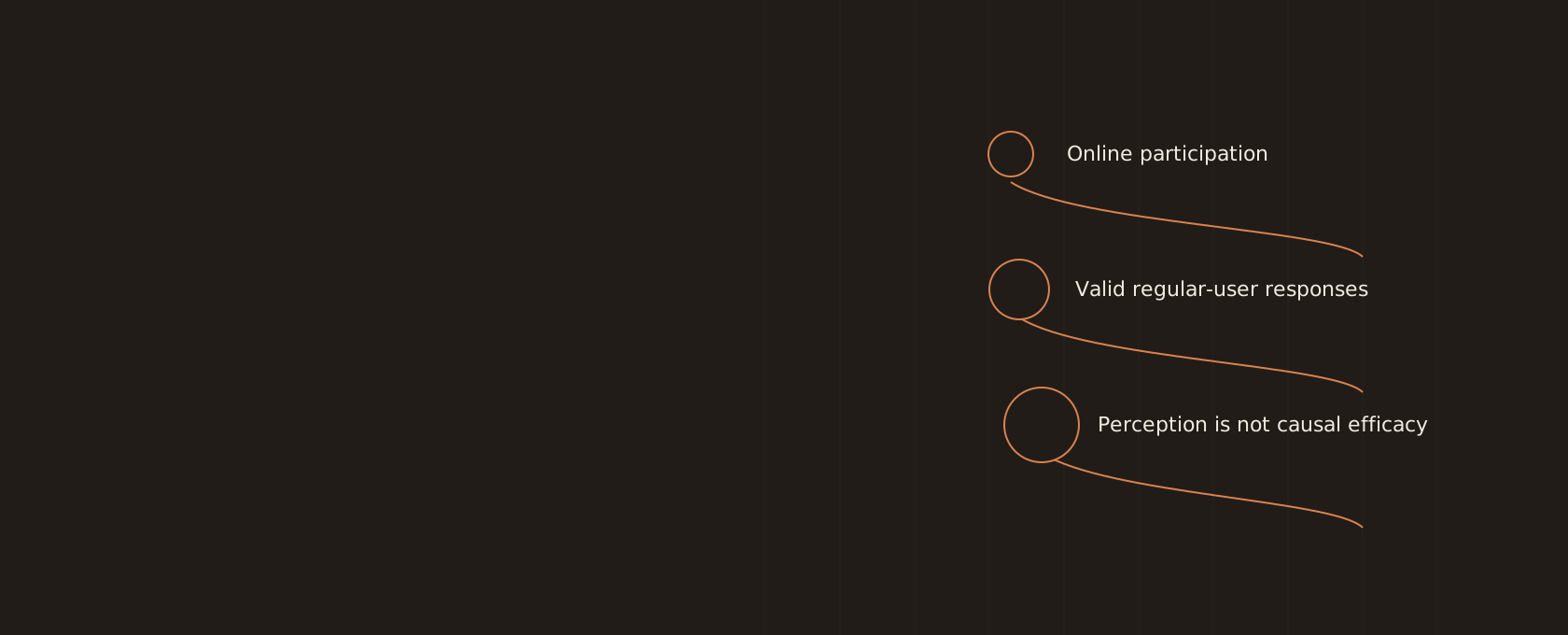
The abstract recorded 572 logins and 482 valid responses. These are different participation stages, and the valid-response count should not be replaced by the larger login count. Nor do logins establish a denominator of all people invited or all potential users worldwide.
A careful account therefore identifies what each number counts before discussing representation or certainty. This page does not derive a population response rate from those figures. A full review would inspect recruitment, exclusions and handling of repeated participation. The reported valid responses define the analysis described in the abstract, with broader inference still constrained by how respondents entered the survey.
| Count or evidence type | What it represents | Do not infer |
|---|---|---|
| Logins | Participation entries recorded | A worldwide invited-population denominator |
| Valid responses | The analyzed questionnaire group | Every potential user is represented |
| Reported sleep benefit | Perceived experience | Objective controlled sleep improvement |
| Adverse reports | Experiences within selected respondents | A general population incidence rate |
Why does regular-user self-selection matter?
The respondents were already sauna users, and their reported profile included many people with favorable lifestyle characteristics. People who enjoy a practice may be more willing to answer a questionnaire about it than people who avoid or discontinue it. Such selection can influence both participation and perceived experience.
These are limits on causal and population interpretation, not a reason to dismiss the reports. The experiences are useful information about the responding group. They simply should not be treated as the expected outcome for every new user or as evidence that sauna caused the whole health profile. Selection and the surrounding behaviors remain part of the story.
What did respondents say they valued?
Reported reasons included relaxation and stress reduction, pain-related interest and socializing. Participants also commonly described perceived sleep benefits. These findings help explain why the practice matters to the people who completed the survey, rather than establishing each motive as a measured clinical outcome.
A reason for participating is not automatically an effect caused by the exposure. Likewise, a reported improvement does not identify how much arose from heat, setting, expectation or other changes. This summary preserves the distinction between motivation, experience and efficacy. It uses the registered qualitative pattern without importing unregistered percentages or presenting one favorable response category as a universal benefit.
Did the wellbeing instrument make the results objective?
The questionnaire incorporated SF-12, a structured quality-of-life instrument assessing reported wellbeing. That is different from objectively recording sleep physiology or assigning a controlled clinical intervention. Instrument validity does not supply randomization or remove selection from an online survey.
The same principle applies to frequency comparisons within respondents. People in different categories can differ in other ways, and the categories were not allocated by investigators. A favorable relationship cannot identify an optimal schedule or prove that increasing frequency would improve a new user’s score. A reader should keep the measurement method, comparison and timing attached before turning reported wellbeing into an intervention claim.
Were the reported experiences all reassuring?
No. Respondents described adverse experiences as well as benefits, with most reported reactions characterized as minor and some more serious experiences also noted. Those reports prevent the survey from being presented as universal reassurance or evidence that nobody encounters difficulties.
The survey cannot establish a reliable population-wide incidence rate from a self-selected sample. Its reporting and denominator differ from a prospective safety study with defined monitoring. This page therefore does not add new numerical harm estimates or infer an individual risk level. The appropriate conclusion retains both sides of the reported experience while leaving personal suitability and formal safety estimation to separate evidence and clinical consideration.
How does population-based MONICA sampling differ?
The northern Sweden MONICA survey began from a population-register sampling frame and compared existing sauna users with nonusers. That differs from an open survey of regular-user experiences. Its sauna analysis still depended on response and showed demographic and lifestyle differences between bathers and non-bathers.
Neither design randomly allocated heat. The contrast helps explain why sampling quality and causal inference should be assessed separately. A population frame can improve one recruitment question without resolving confounding, while an online user survey can reveal motives without estimating a representative effect. The two studies should not be pooled informally as identical independent tests of the same wellbeing outcome.
What is justified after this abstract-level appraisal?
The survey supports a description of selected users’ motives and perceived experiences, including both valued and adverse accounts. It does not establish an objective sleep benefit, a representative population effect, an ideal frequency or personal clearance. The international framing should retain the actual selection boundary.
The indexed abstract and verified corpus abstraction were read. Full recruitment, exclusion rules, statistical comparisons, funding and conflict-of-interest disclosures have not been comprehensively appraised; unreported details remain unknown. The historical safety review provides separate limited context rather than converting survey satisfaction into physical suitability. Further targeted research can investigate the experiences while this source remains a bounded user-report study.
Explore the evidence with a tool.
Questions, considered
Questions about this study
Did the Global Sauna Survey objectively demonstrate better sleep?
No. It recorded participants’ reported experiences, including perceived sleep benefits, rather than measuring sleep with a controlled physiological assessment. Such reports help describe why people value sauna. They do not establish that heat itself caused improved sleep or that every new user should expect the same response.
Follow the sourceWhy does self-selection matter in the Global Sauna Survey?
People who already use and enjoy sauna may be especially likely to complete a survey about it. Respondents also commonly reported other healthy lifestyle characteristics. Those features can influence both perceived wellbeing and participation, limiting conclusions about what would happen if a general population were assigned to start sauna.
Follow the sourceWere adverse experiences absent from the Global Sauna Survey?
No. Respondents described adverse experiences as well as perceived benefits, with most reported reactions characterized as minor. A self-report survey cannot provide a reliable population-wide incidence rate, but the presence of discomfort and occasional serious experiences is a reason to avoid presenting the findings as universal reassurance.
Follow the sourceFollow the evidence
Sources & references
Research summaries in this edition are based on indexed abstracts unless otherwise noted. A source link is not a claim of medical review.
- A hot topic for health: Results of the Global Sauna Survey.
Hussain JN, Greaves RF, Cohen MM
Volume 44, pages 223-234 · PMID 31126560
Open-access flag: not recorded.Abstract-level editorial review - Sauna bathing in northern Sweden: results from the MONICA study 2022.
Engström Å, Hägglund H, Lee E, Wennberg M, Söderberg S, Andersson M
Volume 83, issue 1, pages 2419698 · PMID 39446139
Open-access flag: yes.Abstract-level editorial review - Women's perceptions of sauna bathing and its impact on health and well-being: insights from a cross-sectional study.
Lennkvist M, Hägglund H, Engström Å
Volume 84, issue 1, pages 2595806 · PMID 41340471
Open-access flag: yes.Abstract-level editorial review - Sauna culture improves physical and mental wellbeing in the UK through social connection and ritual.
Newson M, McGrath R, Mosina I, Reason G, Peitz L
Volume 394, pages 119061 · PMID 41679164
Open-access flag: not recorded.Abstract-level editorial review - Benefits and risks of sauna bathing.
Hannuksela ML, Ellahham S
Volume 110, issue 2, pages 118-126 · PMID 11165553
Open-access flag: not recorded.Abstract-level editorial review
What do the other experience studies add?
The women-focused questionnaire described both restorative and uncomfortable experiences within a subset of a larger survey. The UK social paper examined identity and ritual relationships across several components. Those sources add different perspectives rather than direct replications of this global survey’s response pattern.
Their denominators, recruitment and possible overlap need checking before totals are added. A shared sauna label does not make every participant group independent or every question equivalent. Reading across the sources is useful when the variety remains visible: motives, lived experience, social relationships and questionnaire wellbeing can inform one another without becoming one causal clinical-effect estimate or a universal participation format.