| Study | Design & population | Finding & comparison |
|---|---|---|
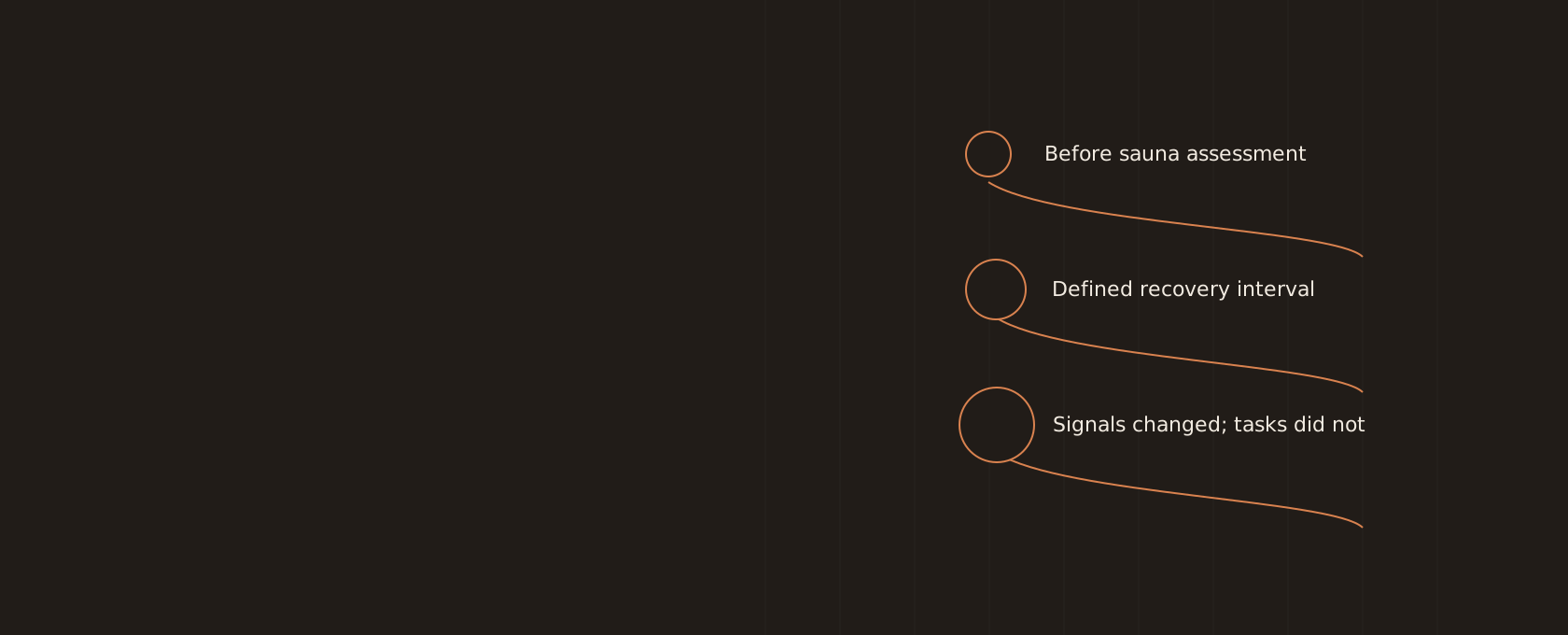
| 2018 · Cernych M ↗ | Before-after EEG and cognitive-task experiment Participants: 16. Finnish sauna-induced hyperthermia | EEG patterns changed after recovery, but measured auditory and visual task performance did not improve significantly. Comparison: Before versus 90-minute recovery Small male sample |
| 2023 · Chang M ↗ | before-and-after neurophysiological experiment participants, demographics not specified in abstract alternating sauna, cold water and rest · three cycles | Brain-signal and task changes accompanied a combined sauna–cold-water ritual. Comparison: before, during rest and after cycles Combined intervention; no isolated sauna effect or clinical cognitive outcome. |
| 2017 · Laukkanen T ↗ | prospective cohort Apparently healthy at enrollment Participants: 2315. habitual sauna | For 4–7 versus 1 session weekly, adjusted HRs were 0.34 (95% CI 0.16–0.71) for dementia and 0.35 (0.14–0.90) for Alzheimer disease. Results describe observed habits in Finnish men, not randomized prevention. Comparison: Once-weekly sauna Shared KIHD cohort with other reports |
Original publication: Post-sauna recovery enhances brain neural network relaxation and improves cognitive economy in oddball tasks.
What was the experiment intended to assess?
The paper investigated brain-network activity, information processing and cognitive-task performance after sauna recovery. It combined resting EEG with task-related recordings before and after the experimental period. These are several related measurements, not a single general test of brain health.
The title’s cognitive-economy language needs to be read beside the actual task result. A signal interpretation can be scientifically interesting without establishing that people performed better. This summary preserves that distinction from the beginning rather than selecting the most favorable phrase and expanding it to memory, productivity or clinical benefit. The experiment asks a defined acute question with a limited observation window.
Who participated, and what is not established about applicability?
The study enrolled sixteen men with a reported young average age. Those source-verified sample features constrain transfer before any EEG interpretation is considered. The abstract does not establish that the same result applies to women, older adults or people seeking assessment for a clinical cognitive concern.
A small selected experiment can provide useful neurophysiological observations while leaving individual prediction unresolved. This page does not infer unreported participant health details or recruit a different clinical population through wording alone. A stronger claim needs a relevant sample and outcome, rather than assuming a brain-related signal is universal because its proposed mechanism sounds general.
When was cognition assessed relative to exposure?
The source compared measurements before sauna with measurements ninety minutes afterward, during post-sauna recovery. That timing is part of the experiment. It should not be described as a test taken continuously through heat exposure or proof of what happens at every recovery stage.
The abstract also describes physiological recovery before the later cognitive assessment. This does not identify an ideal schedule for a real-world task or validate a different home routine. Changing the interval would ask another question. A faithful methods summary keeps the measured stage attached to the finding rather than using the general phrase after sauna as though all time windows and conditions were equivalent.
What kind of EEG changes were reported?
The paper reported changes in resting patterns and task-related electrical components after recovery. Those observations describe neural measurements under the study conditions. They should not be converted into an amount of improved intelligence, a body-wide rejuvenation effect or a clinical diagnosis changing.
The interpretation of relaxation or processing economy belongs to the authors’ account of those recordings. It is not independent proof of a useful functional consequence. This summary therefore avoids new numerical signal effects or generalized enhancement percentages. The relevant next question is whether an appropriately measured behavioral or clinical outcome improved under a suitable comparison, rather than assuming the signal change supplies that outcome.
Did the auditory and visual tasks improve?
No significant improvement in measured task performance was found. That is a central result, not a minor exception to a broad performance claim. The source itself distinguishes the EEG component changes from their insufficient effect on the tested visual and auditory performance.
A null finding is also endpoint-specific. It does not show that every brain response was absent or settle every possible question about sauna and cognition. The correct account retains both parts: signals changed, while performance in the actual tasks did not clearly improve. Removing either part would make the paper less informative and could turn a nuanced acute experiment into a misleading all-purpose brain-benefit or no-effect headline.
| Source element | Reported feature | Do not infer |
|---|---|---|
| EEG recordings | Changed patterns after recovery | A universal clinical brain benefit |
| Task performance | No significant improvement | Behavior improved because signals changed |
| Assessment timing | A defined recovery stage | Every interval or performance setting was tested |
| Cognitive-economy interpretation | A reading of neural measurements | Validated personal memory or productivity gain |
Why does processing economy not equal improved everyday cognition?
A proposed interpretation of how a task is processed does not automatically establish better learning, memory, attention in daily life or clinical functioning. Those outcomes require their own relevant assessments. The term economy should therefore not be treated as a numeric score of personal cognitive improvement.
This distinction protects the useful physiology from overstatement. A laboratory observation may motivate a future task-specific study without becoming a practical performance recommendation. The paper does not validate a personal threshold, identify who will benefit or show that stronger heat yields a better mental result. Its contribution remains the measured recovery-stage patterns and the task null reported alongside them.
What comparison details would a fuller review need?
The indexed abstract does not describe a separate non-sauna time-control condition. A complete appraisal would inspect how task repetition, rest, sequence, analysis and measurement reliability were handled. Those are review questions, not established claims that one factor caused the signal pattern.
Without assuming methods not read, this page does not label the before-and-after finding as a fully isolated heat effect. The comparison remains limited to the described experiment. It is also not a dose trial identifying a universally effective temperature or timing. The absence of a significant behavioral gain should not be replaced by speculation that another unmeasured benefit must have occurred.
How does the combined-ritual study or dementia literature fit?
The totonou paper used hot sauna, cold water and rest, with task and brain-state observations under a different sequence. Its reported behavioral response change cannot be substituted for the null performance finding here. The sources need separate exposure, timing and task labels.
The dementia cohort instead followed habitual exposure and later diagnoses. It cannot demonstrate the acute EEG mechanism or validate a post-recovery cognitive routine. The broader review supplies hypotheses and context rather than another direct experimental population. Reading the sources together is useful only when their distinct outcomes remain visible, without combining a signal interpretation, another task and a later diagnosis into one established causal effect.
What is the justified conclusion from this source?
The source shows acute recovery-stage EEG changes without significant improvement in the tested auditory and visual performance. It does not establish general cognitive enhancement, a clinical disease intervention or an optimal personal schedule. The participant group and timing remain essential to the result.
The indexed abstract and verified source abstraction were read. Complete methods, formal risk of bias, funding and conflict-of-interest disclosures have not been comprehensively assessed; unreported information remains unknown. The historical safety review supplies limited general cautions rather than cognitive clearance. Further controlled work can investigate the signal interpretation while this page retains the actual behavioral null and avoids a practical promise the experiment did not establish.
Explore the evidence with a tool.
Questions, considered
Questions about this study
Did the post-sauna EEG study demonstrate better cognitive task performance?
No. Although several electrical brain-response patterns changed after recovery, performance on the measured auditory and visual tasks did not differ significantly. The distinction is central: a physiological interpretation such as cognitive economy should not be translated into an established improvement in everyday thinking or work performance.
Follow the sourceWhen were the cognitive measurements taken in PMID 30300030?
The comparison included measurements before sauna and after a recovery period, when temperature and heart rate had returned toward baseline. It therefore examined residual effects rather than performance while participants were overheated. Timing should be explicit when comparing its findings with studies of cognition during active heat stress.
Follow the sourceCan the EEG experiment substantiate sauna prevention of dementia?
No. It involved a small group of young men performing short laboratory tasks around a single exposure. Dementia incidence over years is a different outcome in a different population. Electrical-response changes without improved task performance cannot provide a bridge from this experiment to a causal dementia-prevention claim.
Follow the sourceFollow the evidence
Sources & references
Research summaries in this edition are based on indexed abstracts unless otherwise noted. A source link is not a claim of medical review.
- Post-sauna recovery enhances brain neural network relaxation and improves cognitive economy in oddball tasks.
Cernych M, Satas A, Brazaitis M
Volume 35, issue 1, pages 375-382 · PMID 30300030
Open-access flag: not recorded.Abstract-level editorial review - A study on neural changes induced by sauna bathing: Neural basis of the "totonou" state.
Chang M, Ibaraki T, Naruse Y, Imamura Y
Volume 18, issue 11, pages e0294137 · PMID 38011189
Open-access flag: yes.Abstract-level editorial review - Sauna bathing is inversely associated with dementia and Alzheimer's disease in middle-aged Finnish men.
Laukkanen T, Kunutsor S, Kauhanen J, Laukkanen JA
Volume 46, issue 2, pages 245-249 · PMID 27932366
Open-access flag: not recorded.Abstract-level editorial review - Cardiovascular and Other Health Benefits of Sauna Bathing: A Review of the Evidence.
Laukkanen JA, Laukkanen T, Kunutsor SK
Volume 93, issue 8, pages 1111-1121 · PMID 30077204
Open-access flag: not recorded.Abstract-level editorial review - Benefits and risks of sauna bathing.
Hannuksela ML, Ellahham S
Volume 110, issue 2, pages 118-126 · PMID 11165553
Open-access flag: not recorded.Abstract-level editorial review