| Study | Design & population | Finding & comparison |
|---|---|---|
| 2025 · Reed EL ↗ | single-session physiological experiment adults Participants: 10. far-infrared sauna · single session | Muscle temperature rose more near the surface, while intestinal temperature did not materially change. Comparison: before versus after exposure Small acute study; no clinical recovery or deep-tissue efficacy outcome. |
| 2015 · Mero A ↗ | Acute exercise-recovery comparison Healthy physically active male volunteers Participants: 10. Far-infrared and traditional sauna conditions | The abstract reports no recovery differences after the strength session and a higher countermovement jump at one time point after endurance exercise with infrared exposure. It does not directly validate the asserted depth of infrared penetration. Comparison: Recovery with infrared versus no sauna; additional traditional condition Small male-only sample and multiple outcomes. |
| 2023 · Ahokas EK ↗ | randomized crossover experiment basketball players Participants: 16. post-exercise infrared sauna · two trials one week apart | Infrared recovery attenuated the subsequent jump-performance decline and reduced reported soreness in this small sample. Comparison: passive recovery after resistance exercise Small sport-specific acute trial; subjective outcomes; not all performance measures improved. |
Original publication: Muscle temperature increases during a single far infrared sauna session without changes in intestinal temperature.
Did muscle and core temperature show the same response?
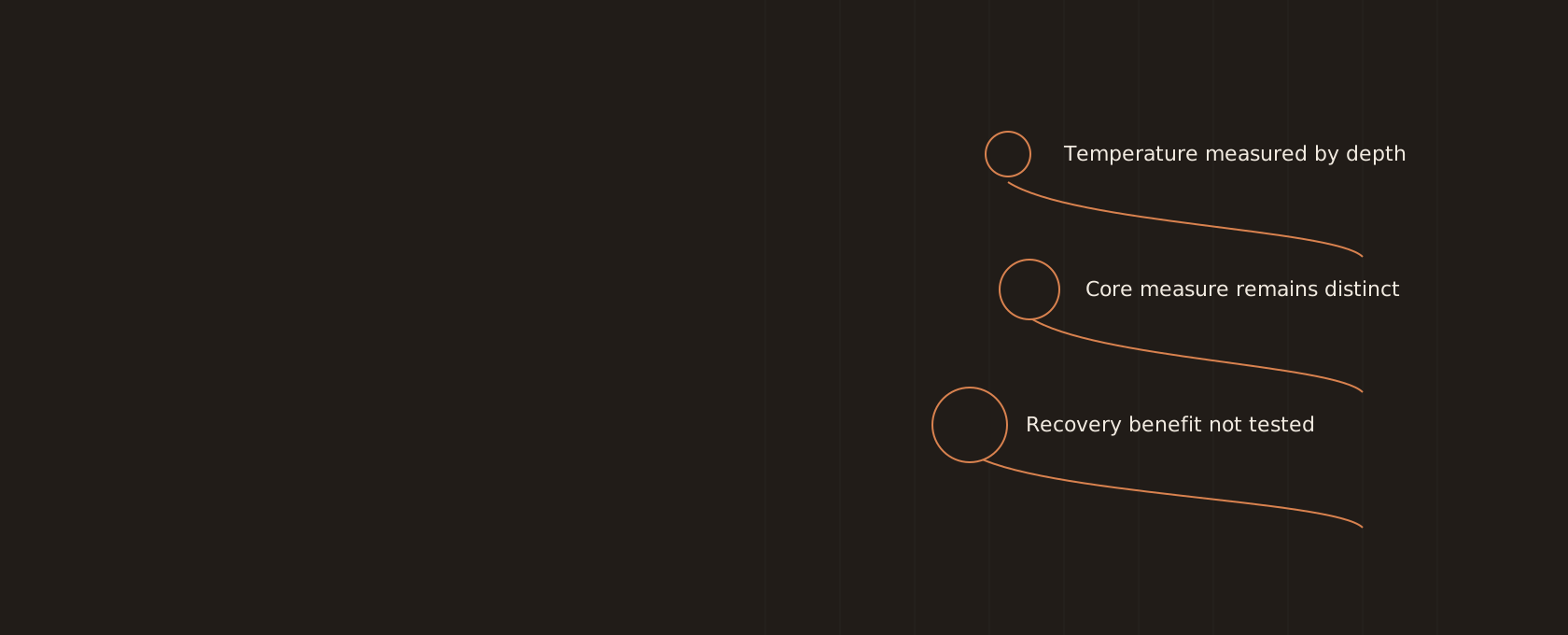
They did not. The experiment reported increases in measured muscle temperature with a smaller response at greater depth, while the intestinal/core temperature measure did not change. That contrast is central to what the study contributes.
A warmer local tissue measurement should not become a statement that every part of the body received the same thermal dose. The source directly assessed selected locations rather than assuming their responses from the room setting or the device label. This makes it useful for evaluating a broad deep-heating claim. The physiological observation remains narrower than a demonstration of improved recovery, strength or long-term health. A paper can measure warming clearly without establishing the clinical result a product description may attach to that warming.
What did the intramuscular probes allow researchers to compare?
The investigators measured temperature at several depths in quadriceps tissue during a single infrared exposure. A multisensor probe allowed a local depth comparison rather than one temperature reading presented as representative of the entire muscle.
The small adult sample and selected tissue locations limit generalization. The experiment did not sample every muscle, device or body configuration. It also did not establish clinical efficacy merely by using a direct physiological measure. A full appraisal would inspect sensor procedures, precision and how measurements were standardized. This summary retains the advantage of directly observing a local response while leaving those technical details for further assessment. The source should not be read as a universal map of heating throughout every user’s tissues or a validated estimate for a different cabin.
Was the warming uniform throughout the measured muscle?
No uniform response was reported. Increases became smaller with increasing distance below the skin. That is a graded pattern, not evidence that all tissue at depth remained unchanged or that every measured region warmed equally. Both exaggerations would distort the result.
This page does not reproduce unregistered effect quantities or translate the measured pattern into a universal penetration depth. A temperature probe observes a local thermal response; a broad claim about radiation penetration and clinical benefit involves additional questions. The useful description stays with the measured depths and the dependence on location. It can challenge an assumption of equal deep heating without denying that some warming was detected at the deeper measured points. Precision in that wording matters because a simple superficial-versus-deep label can hide the continuous pattern.
What does the unchanged intestinal temperature establish?
It establishes the reported finding for that core-related measurement under this exposure. It does not mean that every physiological variable was unchanged: measured muscle and skin responses differed. Nor does it guarantee that another infrared routine or another participant would show the same internal response.
The distinction is useful when studies are compared. A traditional sauna experiment with a different core response is not automatically a contradiction; the heat modality, exposure, sample and measurements may differ. The paper can help identify those variables without proving which one accounts for every difference. A source-led comparison should retain what was measured and avoid replacing it with a room-temperature assumption. This study does not validate using an entered cabin setting to calculate an individual’s internal or muscle temperature.
Did local warming demonstrate improved recovery or strength?
Those outcomes were not established by this experiment. Measuring a temperature difference is distinct from measuring restored force, later jump performance, soreness or muscle size. A response that may be relevant to a proposed mechanism cannot supply every downstream result.
The appropriate next question would identify the specific recovery or training outcome and test it against a suitable comparator. This study did not do that by quantifying local warming. It therefore should not be used to promise faster sports recovery or a muscle-building advantage from an infrared product. The result is still scientifically useful because it improves description of the exposure itself. A clear account of the physical response can support future research without being presented as an already successful clinical or performance intervention.
How do the older and newer recovery experiments fit?
An earlier infrared recovery comparison reported no difference after strength work and a favorable jump observation at one point after endurance exercise. Its abstract also made a penetration assertion not directly validated by its reported recovery tests. Those claims should remain separate from the temperature measurements here.
A basketball crossover measured actual subsequent recovery outcomes and found a smaller jump decline and less soreness after infrared than passive rest. It was not a replication of the probe experiment or proof that a particular depth pattern caused those outcomes. Together, the studies show why physical exposure, mechanism and recovery need their own measurements. A product claim cannot fill a gap by combining one paper’s temperature response with another’s performance finding as if the link had been experimentally established.
Can the probe findings supply a personalized heat routine?
They cannot establish a complete personal protocol. The source assessed one exposure and selected measurements rather than comparing programs to identify an optimum. It did not validate a target local temperature or show that greater heating at depth produces a more desirable outcome.
A planner can organize room and session assumptions, but it cannot reconstruct an individual’s intramuscular response from the device label. The experiment also does not determine medical suitability or a universally effective recovery dose. Those are different questions requiring relevant evidence. The appropriate use is interpretive: ask which tissue or core measure a claim refers to and whether its purported benefit was actually tested. The paper provides a bounded physical observation, not an algorithm for maximizing a biological response at home.
What conclusion and review limits should remain attached?
The grade is C for a small acute physiological experiment. Its useful finding is depth-dependent local warming alongside an unchanged reported intestinal/core measure. It does not establish equal heating throughout the body, clinical efficacy or a guaranteed performance effect from one device or routine.
This appraisal read the indexed abstract and independently refreshed the bibliographic record. Full-text sensor methods, all statistical decisions, formal risk of bias and financial disclosures were not comprehensively assessed. Funding and competing interests remain unreported here rather than presumed absent. The source describes research rather than a routine to copy. A person with a medical condition or medication concern needs a separate clinical discussion; a local temperature response does not provide personal clearance or demonstrate that a more demanding exposure would be beneficial.
Explore the evidence with a tool.
Questions, considered
Questions about this study
Did the far-infrared muscle-temperature study find uniform deep heating?
No. Temperature increases became smaller with increasing depth in the measured quadriceps tissue. The authors interpreted the response as predominantly superficial heating. This does not support treating an infrared device as delivering the same thermal dose throughout muscle, nor establish clinical benefits from the measured warming.
Follow the sourceDid intestinal temperature rise in the muscle-probe infrared experiment?
No meaningful change in core temperature was reported despite increases in skin and measured muscle temperatures. That contrast is central to the study. A warmer muscle measurement should not be presented as evidence that this exposure substantially raised internal body temperature or reproduced another sauna protocol.
Follow the sourceDid measuring muscle warming prove faster sports recovery?
No. The experiment quantified temperature at different tissue depths during one infrared session. It did not test restored strength, subsequent competition performance or recovery from injury. Physiological warming is a distinct outcome, so any recovery claim would need a study measuring the recovery outcome directly.
Follow the sourceFollow the evidence
Sources & references
Research summaries in this edition are based on indexed abstracts unless otherwise noted. A source link is not a claim of medical review.
- Muscle temperature increases during a single far infrared sauna session without changes in intestinal temperature.
Reed EL, Uzoekwe CC, Atencio JK, Minson CT, Halliwill JR
Volume 138, issue 6, pages 1628-1637 · PMID 40331900
Open-access flag: not recorded.Abstract-level editorial review - Effects of far-infrared sauna bathing on recovery from strength and endurance training sessions in men.
Mero A, Tornberg J, Mäntykoski M, Puurtinen R
Volume 4, pages 321 · PMID 26180741
Open-access flag: yes.Abstract-level editorial review - A post-exercise infrared sauna session improves recovery of neuromuscular performance and muscle soreness after resistance exercise training.
Ahokas EK, Ihalainen JK, Hanstock HG, Savolainen E, Kyröläinen H
Volume 40, issue 3, pages 681-689 · PMID 37398966
Open-access flag: yes.Abstract-level editorial review - Benefits and risks of sauna bathing.
Hannuksela ML, Ellahham S
Volume 110, issue 2, pages 118-126 · PMID 11165553
Open-access flag: not recorded.Abstract-level editorial review