| Study | Design & population | Finding & comparison |
|---|---|---|
| 2017 · Munemoto T ↗ | Uncontrolled pilot before-and-after study Patients diagnosed with chronic fatigue syndrome Participants: 11. Clinical Waon therapy | Regional cerebral blood flow and symptoms changed after Waon exposure in the small uncontrolled group. The design cannot establish that blood-flow changes caused symptom improvement. Comparison: Measurements before versus after exposure; no separate control described No separate control group is described. |
| 2015 · Soejima Y ↗ | Uncontrolled inpatient pilot Inpatients with chronic fatigue syndrome Participants: 10. Clinical far-infrared Waon therapy · 4weeks | Fatigue was lower after the program but not significantly lower at the midpoint. Pain and vigor did not significantly change. No adverse effects were reported in this small inpatient group. Comparison: Before versus during and after the program Uncontrolled small inpatient sample. |
| 2015 · Sobajima M ↗ | Uncontrolled clinical before-and-after study Patients with chronic heart failure Participants: 49. Clinical far-infrared Waon therapy · 3weeks | Physical and mental quality-of-life scores improved alongside several clinical measurements. Mental and physical changes did not track identically, and an uncontrolled design cannot isolate heat effects. Comparison: Baseline versus follow-up; no separate control described No separate control group described. |
Original publication: Increase in the Regional Cerebral Blood Flow following Waon Therapy in Patients with Chronic Fatigue Syndrome: A Pilot Study.
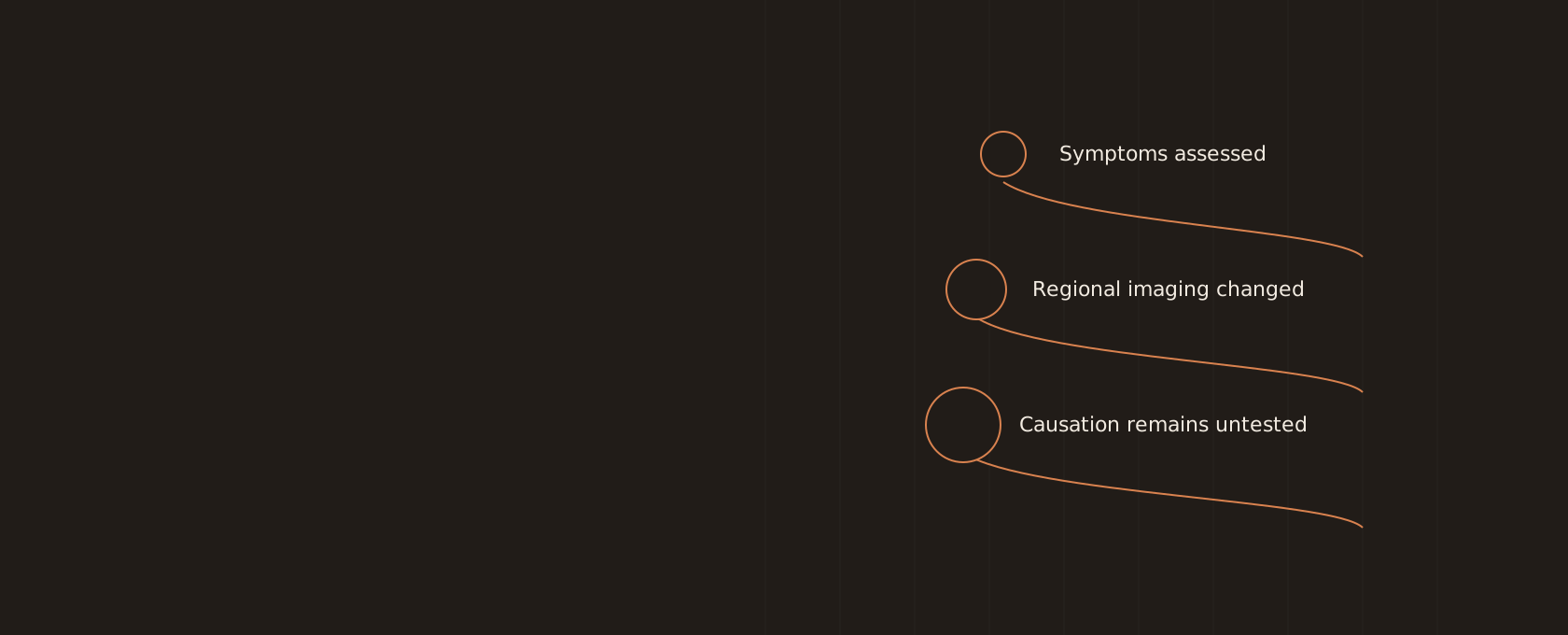
The study joined symptoms with regional imaging
This pilot examined symptoms and regional cerebral blood flow before and after Waon in people diagnosed with chronic fatigue syndrome. It used brain perfusion imaging rather than a simple report of how warm or alert someone felt. The measurement is specific and should retain its clinical and technical context.
The paper reported changes in both symptoms and regional flow. That is an observation requiring careful interpretation, not a completed causal explanation. The source did not assign a comparison designed to separate thermal exposure from other influences. Nor did it establish a program for healthy people with ordinary tiredness. The purpose of this summary is to preserve the imaging question without allowing its technical vocabulary to make an uncontrolled symptom finding seem definitive.
The participant group was small and clinically selected
The abstract describes eleven patients with the diagnosis, including women and men, rather than a representative survey of everyone who experiences fatigue. The small sample and clinical selection limit the precision and transfer of its findings.
A reader should not assume the same result in another diagnosis, age or exposure setting. The source’s enrollment conditions also do not provide an individual self-screening method. A complete review would inspect recruitment and clinical criteria in full text, along with concurrent care and participation flow. This abstract-level appraisal does not reconstruct those details from related publications. It retains the defined clinical sample and leaves unreported information unknown rather than treating a broadly favorable conclusion as general clearance.
Regional flow and symptoms were reported to change
The authors reported symptom improvement alongside increased blood flow in selected brain regions. The registered interpretation retains this qualitative direction without adding numerical imaging effects that have not been separately verified in the fact registry.
A regional measurement should not be extended automatically to every part of brain function. It also should not be interpreted as a clinical diagnosis or a validated marker of how much an individual will improve. The observation is interesting because it offers a more specific mechanistic question, not because it removes the need for an appropriate control. A careful account can recognize the reported signal while leaving its meaning, reproducibility and relation to meaningful longer-term outcomes unsettled.
The measured regions also should not become a whole-brain claim. Regional imaging and a clinical symptom rating are separate observations, and neither supplies a validated personal diagnostic threshold or forecast for an individual reader.
Parallel change does not establish mediation
The fact that symptoms and imaging differed after the same program does not demonstrate that the imaging change produced the symptom response. Both could be influenced by other aspects of care, time or measurement. Establishing mediation requires stronger design and analysis than observing the two together.
This is especially important because the paper’s conclusion uses more causal language. The source-level appraisal should follow the methods rather than adopt every implication of the title or conclusion. It does not deny that a pathway could exist. It identifies a hypothesis that remains to be tested under appropriate comparisons. Without that distinction, technical imaging language can turn plausibility into an apparent clinical explanation that the study has not established.
The earlier inpatient fatigue report remains uncontrolled
The related inpatient Waon pilot found lower fatigue after its program, but not a significant midpoint reduction. Pain and vigor did not change significantly. Those mixed outcomes should not be replaced by the imaging paper’s broader symptom language.
The reports may add different measurements, but independent recruitment or participant overlap cannot be determined here from their abstracts alone. Counting both sample totals as separate confirmation would require a full-methods check. The earlier pilot does not supply a randomized control for the imaging series, and the imaging does not provide one for the symptom pilot. Their roles are distinct observations that can help formulate research questions, not a completed demonstration of heat efficacy and mechanism.
A different clinical quality-of-life response is not replication
The chronic-heart-failure Waon report described quality-of-life and functional changes in a different uncontrolled patient group. Its physical and mental components did not track identically. That source illustrates the need to keep symptoms, function and questionnaire domains separate, not to combine all clinical responses as evidence for one fatigue mechanism.
The populations and outcomes differ from the present imaging series. A favorable mental-component score in heart failure does not establish the same cerebral-flow pathway or reproduce a chronic-fatigue result. Contextual studies can clarify the breadth of clinical research while remaining indirect. Their inclusion should not imply that every source independently tested the imaging hypothesis or confirmed a universal effect of ordinary sauna use.
The findings do not supply a personal exposure strategy
No validated temperature, frequency or maintenance plan follows from the abstract. The clinical program cannot be equated with every infrared cabin or ordinary sauna merely because they involve heat. Borrowing exposure details from another study would create a new untested routine.
This source also does not justify changing clinical care or offering exercise instructions for the diagnosis. A person considering heat exposure should discuss their actual circumstances with a qualified clinician. The emerging grade reflects a small uncontrolled mechanistic observation, not proof of a general fatigue intervention. Source-specific interest and personal suitability are separate questions, and the imaging result does not bridge that gap on its own.
Access, review scope and next evidence
The indexed abstract was refreshed and checked against the included corpus and registered fact. PubMed and the DOI identify the original publication. Full imaging procedures, eligibility, statistical choices, funding and conflicts of interest have not been comprehensively audited here; unreported details remain unknown.
A stronger study would need an appropriate comparison, transparent participant flow and a design able to investigate how imaging and symptoms relate. Independent replication would also help address transfer beyond this small clinical group. The present summary retains the observed changes and the uncertainty without converting them into a diagnostic claim, a personal heat prescription or an established causal account of symptom improvement.
Explore the evidence with a tool.
Questions, considered
Questions about this study
What did the chronic-fatigue cerebral-blood-flow Waon pilot investigate?
The pilot examined symptoms and regional brain blood-flow imaging before and after Waon therapy in people diagnosed with chronic fatigue syndrome. The authors reported changes in both. Because no separate control group is described, the study cannot isolate the effect of heat from other explanations for improvement.
Follow the sourceDoes the Waon brain-imaging pilot prove why chronic-fatigue symptoms changed?
It does not prove the proposed mechanism. Regional blood flow and symptoms were measured around the same intervention, but parallel changes do not demonstrate that one produced the other. A controlled design and stronger mechanistic testing would be needed before making that causal explanation for symptom improvement.
Follow the sourceWho participated in the chronic-fatigue Waon imaging pilot?
The abstract describes eleven patients with chronic fatigue syndrome, including two men and nine women, with a mean age of 27 years. That small clinical sample limits generalization. Its findings should not be presented as evidence about ordinary fatigue, healthy sauna users or every person with this diagnosis.
Follow the sourceFollow the evidence
Sources & references
Research summaries in this edition are based on indexed abstracts unless otherwise noted. A source link is not a claim of medical review.
- Increase in the Regional Cerebral Blood Flow following Waon Therapy in Patients with Chronic Fatigue Syndrome: A Pilot Study.
Munemoto T, Soejima Y, Masuda A, Nakabeppu Y, Tei C
Volume 56, issue 14, pages 1817-1824 · PMID 28717076
Open-access flag: yes.Abstract-level editorial review - Effects of Waon therapy on chronic fatigue syndrome: a pilot study.
Soejima Y, Munemoto T, Masuda A, Uwatoko Y, Miyata M, Tei C
Volume 54, issue 3, pages 333-338 · PMID 25748743
Open-access flag: not recorded.Abstract-level editorial review - Waon therapy improves quality of life as well as cardiac function and exercise capacity in patients with chronic heart failure.
Sobajima M, Nozawa T, Fukui Y, Ihori H, Ohori T, Fujii N, Inoue H
Volume 56, issue 2, pages 203-208 · PMID 25740582
Open-access flag: not recorded.Abstract-level editorial review - Benefits and risks of sauna bathing.
Hannuksela ML, Ellahham S
Volume 110, issue 2, pages 118-126 · PMID 11165553
Open-access flag: not recorded.Abstract-level editorial review