| Study | Design & population | Finding & comparison |
|---|---|---|
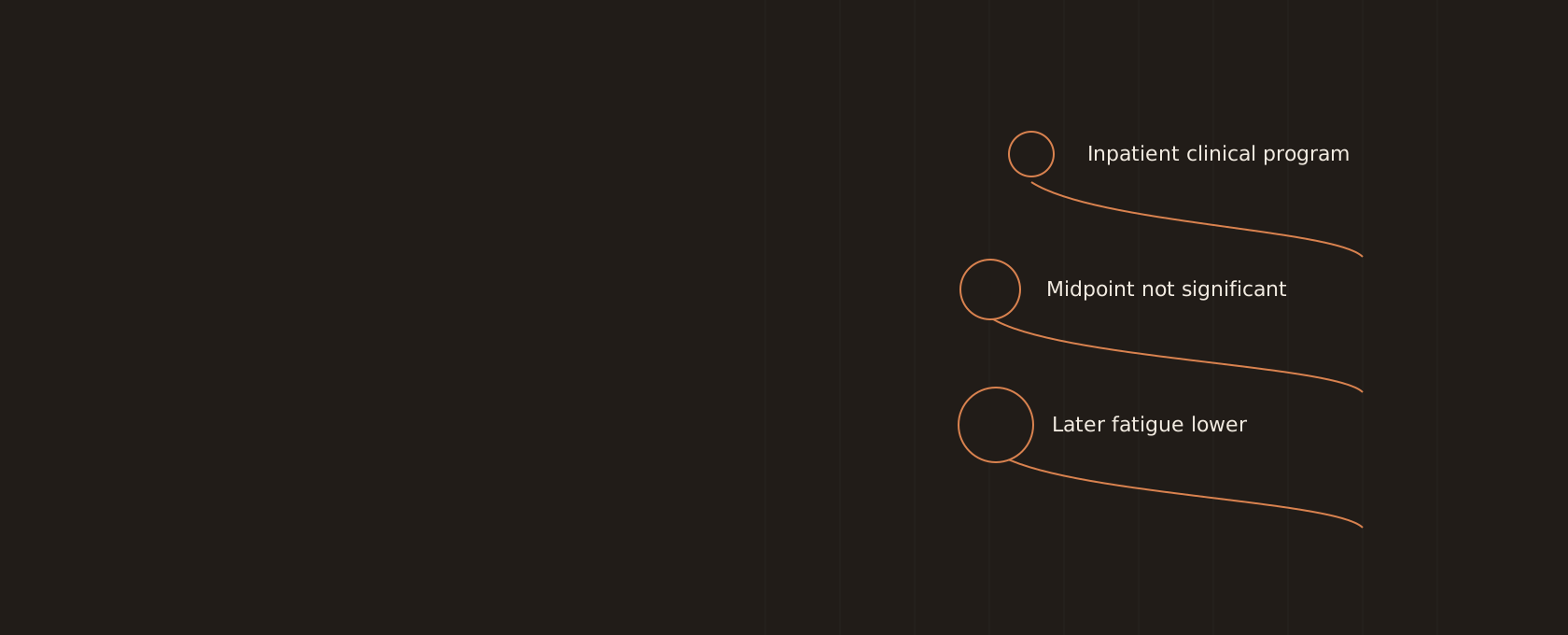
| 2015 · Soejima Y ↗ | Uncontrolled inpatient pilot Inpatients with chronic fatigue syndrome Participants: 10. Clinical far-infrared Waon therapy · 4weeks | Fatigue was lower after the program but not significantly lower at the midpoint. Pain and vigor did not significantly change. No adverse effects were reported in this small inpatient group. Comparison: Before versus during and after the program Uncontrolled small inpatient sample. |
| 2017 · Munemoto T ↗ | Uncontrolled pilot before-and-after study Patients diagnosed with chronic fatigue syndrome Participants: 11. Clinical Waon therapy | Regional cerebral blood flow and symptoms changed after Waon exposure in the small uncontrolled group. The design cannot establish that blood-flow changes caused symptom improvement. Comparison: Measurements before versus after exposure; no separate control described No separate control group is described. |
| 2020 · Sugie M ↗ | Uncontrolled before-after intervention Community-dwelling pre-frail or frail older adults Participants: 67. Far-infrared low-temperature sauna · 3 months | Several functional and symptom measures improved, but most participants had unchanged frailty scores and no untreated comparison was described. Comparison: Before versus after program No untreated control described |
Original publication: Effects of Waon therapy on chronic fatigue syndrome: a pilot study.
The pilot studied a diagnosis and a clinical setting
This paper examined Waon in inpatients diagnosed with chronic fatigue syndrome. It was not a trial of ordinary tiredness in healthy sauna users or a universal approach to restoring energy. The source’s clinical population should remain attached to every result.
Waon was a defined far-infrared program that included a subsequent rest procedure. The existence of a sauna device does not make every recreational exposure an equivalent intervention. The useful question is what this small program observed under its own conditions. It cannot establish that a person with another cause of fatigue, a different medical history or a different home routine would experience the same response. This summary does not provide exercise or heat instructions for people with the diagnosis.
The sample was small and had no separate control
The study followed ten consecutive inpatients before, during and after the program. The abstract did not describe a separate untreated or sham comparison group. That design can identify an observation worth investigating, but it does not show what would have happened over the same period without the intervention.
Concurrent care, attention, expectations and measurement variation remain possible influences. A favorable before-and-after result therefore cannot be attributed solely to thermal exposure. The small sample also limits precision and applicability. Those boundaries should remain visible rather than being treated as minor qualifications after a strong clinical promise. The registered finding is a preliminary symptom pattern in a selected inpatient series, not randomized evidence for a general fatigue program.
Fatigue did not improve significantly at the midpoint
Perceived fatigue was the primary outcome, assessed with a numerical rating scale. The abstract reports no significant reduction at the during-program assessment, with a reduction after the program. The timing should not be shortened into an immediate benefit after a single visit.
A later favorable measurement also does not establish persistence after stopping or identify which component caused the change. The source observed a trajectory over its program rather than assigning different durations to find an optimum. A reader should therefore preserve the assessment occasions when discussing the result. The paper does not establish a universal time-to-benefit or a reason for someone to continue exposure until a particular response is obtained.
A lower reported fatigue rating is also not the same outcome as diagnostic remission or return to every previous activity. This summary does not manufacture a responder rate or a recovery classification from the direction of the group measurement.
Pain and vigor did not show the same pattern
The abstract reported that pain and vigor did not change significantly, while fatigue and selected mood or performance measures were more favorable. These are different outcomes. A broad statement that every symptom improved would omit important null findings.
The presence of a null outcome does not make the fatigue observation disappear, and a favorable fatigue score does not supply the missing pain or vigor result. Each measurement needs its own interpretation. This is particularly important when the paper is cited beyond its original context, where a general wellness claim can merge several symptoms into one idea of recovery. The source supports a specific mixed result rather than a uniform restoration claim.
The imaging pilot adds a mechanism question, not proof
The regional cerebral-flow Waon study reported changes in symptoms and imaging in another small clinical report. It was also uncontrolled. Parallel symptom and blood-flow changes do not establish that one caused the other or that the thermal component was the sole reason for either.
Possible overlap or shared recruitment across related clinical series needs checking in full methods before their participant numbers are added as independent evidence. This abstract-level appraisal does not establish that relationship. The imaging paper can motivate mechanistic investigation without completing a causal explanation for the inpatient fatigue result. Its findings should not be presented as a validated method for improving brain function or as proof that a home sauna reproduces the clinical program.
An older-adult frailty study is not direct fatigue replication
The older-adult infrared program reported changes in several functional and symptom measures, while most frailty scores were unchanged. It involved community-dwelling pre-frail or frail older people and lacked an untreated comparator in the abstract. That is a different population and outcome framework from this inpatient chronic-fatigue series.
The two reports cannot be combined into a single causal effect on energy. A frailty classification, walking test and perceived fatigue rating are not interchangeable. Clinical research across different groups can be informative when the distinctions are preserved. It becomes misleading when an apparently favorable conclusion in one study is used to supply missing control, durability or generalizability in another.
No reported events does not validate public use
No adverse effects were reported in the small inpatient group. That is a source-specific observation, not proof of general safety or exclusion of uncommon reactions. The participants received a clinical program under conditions that should not be assumed equivalent to unsupervised use.
The finding does not justify adopting the protocol, changing existing care or following an exercise plan based on this source. A qualified clinician should consider the actual diagnosis, symptoms, medications and intended exposure separately. The emerging grade reflects limited preliminary evidence with a favorable later fatigue measurement and important null and design limits. It is not a validated treatment schedule or personal clearance for someone with chronic fatigue syndrome.
Source verification and unassessed details
The indexed abstract was refreshed and compared with the included corpus and registered result. The original PubMed entry and DOI identify the publication. Full eligibility criteria, concurrent care, missing-data procedures, formal risk of bias, funding and conflicts of interest were not comprehensively assessed. Details not established from the reviewed material remain unknown.
A stronger test would need a relevant comparison and clear outcomes and follow-up rather than another positive-sounding uncontrolled series. This summary keeps the source’s actual observation in view: fatigue was lower at the end, not significantly lower midway, and pain and vigor remained null. The clinical setting and uncertainty are part of the result, not obstacles to remove when communicating it.
Explore the evidence with a tool.
Questions, considered
Questions about this study
Did every measured symptom improve in the inpatient chronic-fatigue Waon pilot?
No. The abstract reports improvement in fatigue after the program and in selected mood and performance measures, while pain and vigor did not change significantly. Preserving these null findings matters. Summarizing the pilot as a general improvement across all symptoms would overstate what was actually measured and reported.
Follow the sourceDoes no reported harm in the chronic-fatigue Waon pilot establish general safety?
It does not establish general safety. The abstract describes a small inpatient group receiving a defined clinical program. An absence of reported adverse effects in that group cannot rule out uncommon events, identify every vulnerable subgroup, or validate unsupervised heat exposure for everyone with chronic fatigue syndrome.
Follow the sourceWas fatigue already significantly improved halfway through the chronic-fatigue Waon pilot?
The abstract reports no statistically significant fatigue reduction during the midpoint assessment, with a reduction reported after the program. That timing should be preserved rather than suggesting an immediate effect. Without a separate control group, even the later improvement cannot be attributed conclusively to Waon exposure alone.
Follow the sourceFollow the evidence
Sources & references
Research summaries in this edition are based on indexed abstracts unless otherwise noted. A source link is not a claim of medical review.
- Effects of Waon therapy on chronic fatigue syndrome: a pilot study.
Soejima Y, Munemoto T, Masuda A, Uwatoko Y, Miyata M, Tei C
Volume 54, issue 3, pages 333-338 · PMID 25748743
Open-access flag: not recorded.Abstract-level editorial review - Increase in the Regional Cerebral Blood Flow following Waon Therapy in Patients with Chronic Fatigue Syndrome: A Pilot Study.
Munemoto T, Soejima Y, Masuda A, Nakabeppu Y, Tei C
Volume 56, issue 14, pages 1817-1824 · PMID 28717076
Open-access flag: yes.Abstract-level editorial review - Effectiveness of a far-infrared low-temperature sauna program on geriatric syndrome and frailty in community-dwelling older people.
Sugie M, Harada K, Takahashi T, Nara M, Fujimoto H, Kyo S, Ito H
Volume 20, issue 10, pages 892-898 · PMID 32776407
Open-access flag: yes.Abstract-level editorial review - Benefits and risks of sauna bathing.
Hannuksela ML, Ellahham S
Volume 110, issue 2, pages 118-126 · PMID 11165553
Open-access flag: not recorded.Abstract-level editorial review