| Study | Design & population | Finding & comparison |
|---|---|---|
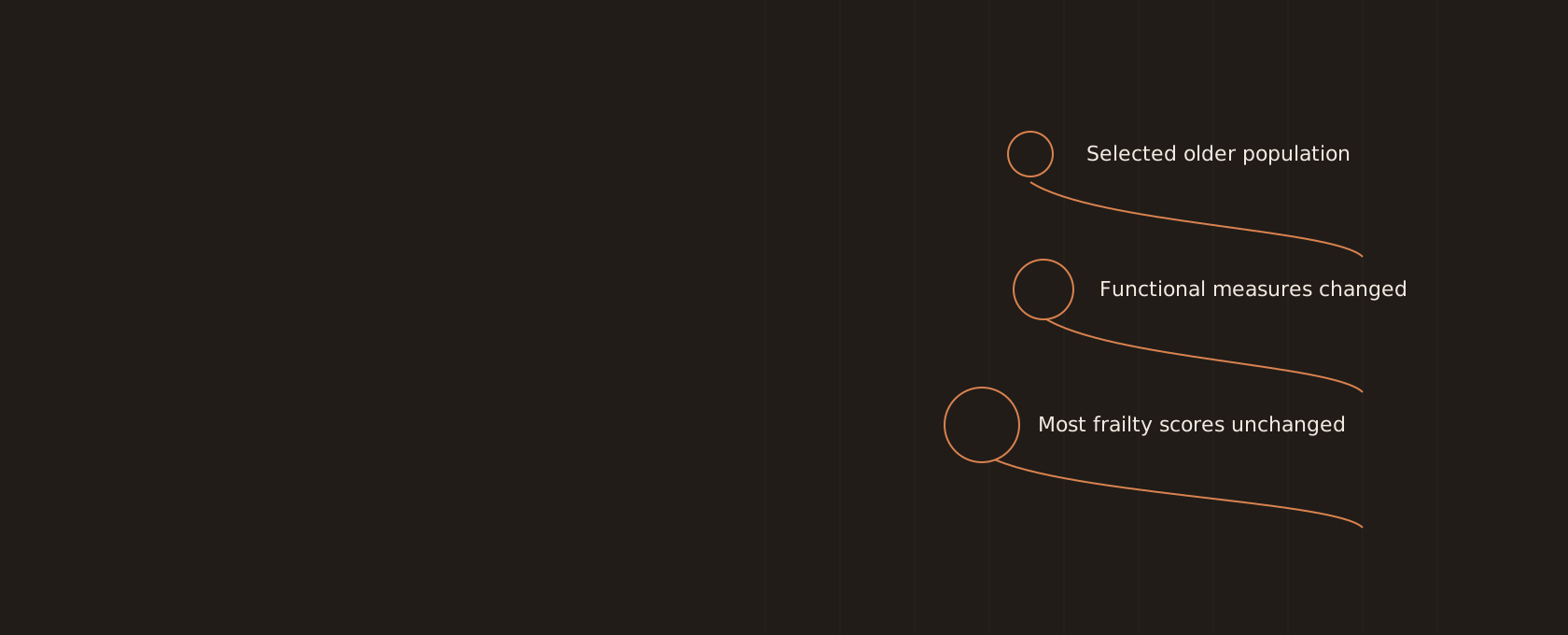
| 2020 · Sugie M ↗ | Uncontrolled before-after intervention Community-dwelling pre-frail or frail older adults Participants: 67. Far-infrared low-temperature sauna · 3 months | Several functional and symptom measures improved, but most participants had unchanged frailty scores and no untreated comparison was described. Comparison: Before versus after program No untreated control described |
| 2015 · Soejima Y ↗ | Uncontrolled inpatient pilot Inpatients with chronic fatigue syndrome Participants: 10. Clinical far-infrared Waon therapy · 4weeks | Fatigue was lower after the program but not significantly lower at the midpoint. Pain and vigor did not significantly change. No adverse effects were reported in this small inpatient group. Comparison: Before versus during and after the program Uncontrolled small inpatient sample. |
| 2026 · Bekfani T ↗ | prospective uncontrolled mechanistic pilot Stable HFpEF outpatients; 18 completers Participants: 18. supervised sauna · 10-week intervention; follow-up 3 months after sauna withdrawal | Completers improved several functional measures during supervised exposure, with some exercise benefits declining after withdrawal; no adverse events were reported. Comparison: Own baseline and withdrawal follow-up Eighteen completers |
Original publication: Effectiveness of a far-infrared low-temperature sauna program on geriatric syndrome and frailty in community-dwelling older people.
The program studied a defined older population
The participants were community-dwelling older people in Japan classified as pre-frail or frail. The study reassessed several functional, symptom and questionnaire measures after an infrared program. It was not a trial of every older adult or a general anti-aging intervention.
That population definition is central to applicability. A person with different mobility, medical needs or living circumstances is not directly represented merely by being older. The source can provide a preliminary observation within its selected setting without identifying a universal routine. This summary keeps functional tests, symptoms and frailty classification separate so that a broad favorable conclusion does not imply that every dimension improved or that the program caused a general restoration of health.
The abstract did not describe an untreated comparison group
The program used a before-and-after assessment rather than a separately described untreated control. Participants’ measurements changed over time, but the design does not establish what would have happened under a comparable alternative or no added intervention.
Concurrent activity, attention, care and repeated testing remain possible contributors. These limits should not be erased by the presence of several favorable endpoints. An uncontrolled study can help plan a more direct test without supplying the same causal evidence as randomized allocation. A source-level account should therefore describe the observed differences and ask which comparison would isolate the program’s contribution, rather than treating the mere sequence of exposure followed by measurement as proof of efficacy.
Several functional and symptom measures changed
The report described differences in walking, peak exercise measurement, selected questionnaire outcomes and the severity of several geriatric symptoms. These are distinct endpoints rather than one common score for improved energy. Their meaning depends on the measure and the actual comparison.
A favorable result for one test should not be transferred automatically to every symptom or to longer-term clinical outcomes. A walking change is not a count of falls, a questionnaire change is not a diagnosis being reversed, and a physiological measure is not lifespan. This summary retains the registered qualitative result without adding numerical effect sizes. It recognizes the potential value of the observations while leaving clinical relevance and attribution to a stronger design and fuller appraisal.
Most frailty scores were unchanged
Most participants had no change in the reported frailty score. That distribution belongs beside the selected favorable functional results. A summary that says simply that frailty improved would give an incomplete impression of what the abstract reported.
The source also uses ambiguous wording for one smaller subgroup. This appraisal does not translate that wording into an invented direction or silently correct it from general knowledge of the instrument. Full-text confirmation is needed before a detailed subgroup table is reproduced. The narrower supported conclusion is sufficient: the majority were unchanged, while other measured responses varied. Preserving that limit prevents a positive overall conclusion from becoming a claim that each participant improved or that every component of a clinical frailty classification moved favorably.
The source therefore warrants an outcome ledger rather than a vote based on its conclusion. Record the frailty distribution separately from selected walking, exercise and questionnaire changes before deciding which statement the study supports.
Function and fatigue are not interchangeable
The chronic-fatigue inpatient Waon pilot assessed a different clinical population with perceived fatigue as its main outcome. Its fatigue measurement was lower at the end but not significantly lower midway, and pain and vigor were null. Those findings cannot be used to replace the older-adult study’s actual endpoints.
The reverse is also true. Selected walking or symptom changes in older adults do not establish an intervention for ordinary tiredness or chronic fatigue syndrome. The studies can inform related questions about function and reported experience while retaining population and measurement boundaries. A broad restoration claim would merge outcomes that were not tested under a common comparison and create apparent consistency by losing the distinctions that matter.
A supervised HFpEF pilot is another clinical question
The HFpEF program reported functional improvements in selected stable outpatients with a different diagnosis, using their own baseline and later withdrawal follow-up. Some exercise-capacity measures declined after the program ended. That adds a durability question but does not supply a controlled replication of the older-adult findings.
Neither pilot retrospectively randomizes the other. Their populations, interventions and follow-up differ. Reading them together is useful when it clarifies which functional measure changed in which setting, not when it produces a universal claim that infrared or sauna restores capacity in every clinical group. A stronger evidence base would need appropriately matched comparisons and independent replication for the specific outcomes and populations being discussed.
Clinical suitability cannot be read from participation alone
Completion of a selected program does not establish that the same exposure is appropriate for every older person. The abstract does not provide a comprehensive individual safety assessment or a validated home schedule. A personal decision needs the relevant health and medication context.
This summary does not recommend escalating heat, adopting the study frequency or changing existing care. The historical safety review supplies limited named cardiac and alcohol cautions rather than exhaustive clearance for frailty or other conditions. Discuss intended exposure with a qualified clinician when relevant. The emerging grade describes preliminary observations in a particular group, with major causal and applicability limits, not a routine that everyone should pursue for functional restoration.
Source verification and the justified conclusion
The indexed abstract was refreshed and compared with the included corpus and fact statement. The original PubMed record and DOI identify the publication. Full assessment procedures, participant selection, missing outcomes, funding and conflicts of interest have not been comprehensively reviewed. Unreported details and the subgroup wording issue remain unresolved rather than filled from assumptions.
The useful conclusion is precise: selected function and symptom measures differed after an uncontrolled program, while most frailty scores were unchanged. A controlled trial would be needed to isolate the contribution and determine persistence. This source does not establish a universal clinical, fatigue or aging benefit, and the majority-unchanged result should remain visible whenever the broader favorable title is repeated.
Explore the evidence with a tool.
Questions, considered
Questions about this study
Did every older participant improve frailty status in the infrared program?
No. Most participants had no change in their frailty score, while selected functional and symptom measures changed. The indexed abstract uses ambiguous wording for one smaller subgroup, so its direction should not be reassigned without full-text confirmation. The uncontrolled before-and-after design also cannot isolate which changes were caused by the infrared program.
Follow the sourceCan the Japanese frailty study establish that infrared sauna caused the changes?
Not confidently from its before-and-after design. The abstract does not describe an untreated control group, so concurrent changes, attention and measurement variability remain possible explanations. The results are useful preliminary observations, but a controlled trial would be needed to isolate the contribution of the infrared program.
Follow the sourceWas the older-adult infrared study evidence for a universal anti-aging routine?
No. It studied community-dwelling older people classified as pre-frail or frail in a defined program. Functional measures and symptom ratings were reassessed afterward. Those endpoints are clinically interesting but do not establish slower biological aging, longer lifespan or suitability of the same routine for all older adults.
Follow the sourceFollow the evidence
Sources & references
Research summaries in this edition are based on indexed abstracts unless otherwise noted. A source link is not a claim of medical review.
- Effectiveness of a far-infrared low-temperature sauna program on geriatric syndrome and frailty in community-dwelling older people.
Sugie M, Harada K, Takahashi T, Nara M, Fujimoto H, Kyo S, Ito H
Volume 20, issue 10, pages 892-898 · PMID 32776407
Open-access flag: yes.Abstract-level editorial review - Effects of Waon therapy on chronic fatigue syndrome: a pilot study.
Soejima Y, Munemoto T, Masuda A, Uwatoko Y, Miyata M, Tei C
Volume 54, issue 3, pages 333-338 · PMID 25748743
Open-access flag: not recorded.Abstract-level editorial review - Effects of Sauna bathing on Exercise Capacity and Muscle Function in HFpEF.
Bekfani T, Abo Hwach A, Moebert R, Seibel S, Burger A, Kaehne T, M Bekhite M, Vargas KG, Janashia M, Groscheck T, Daboul A, Rauwolf T, Behrendt T, Lichtenauer M, Paar V, Lemmer P, Friede T, Schega L, Biering-Sorensen T, Schulze PC, Anker SD, von Haehling S, Schmeisser A, Braun-Dullaeus RC
, pages xuag082 · PMID 41831305
Open-access flag: not recorded.Abstract-level editorial review - Benefits and risks of sauna bathing.
Hannuksela ML, Ellahham S
Volume 110, issue 2, pages 118-126 · PMID 11165553
Open-access flag: not recorded.Abstract-level editorial review